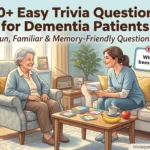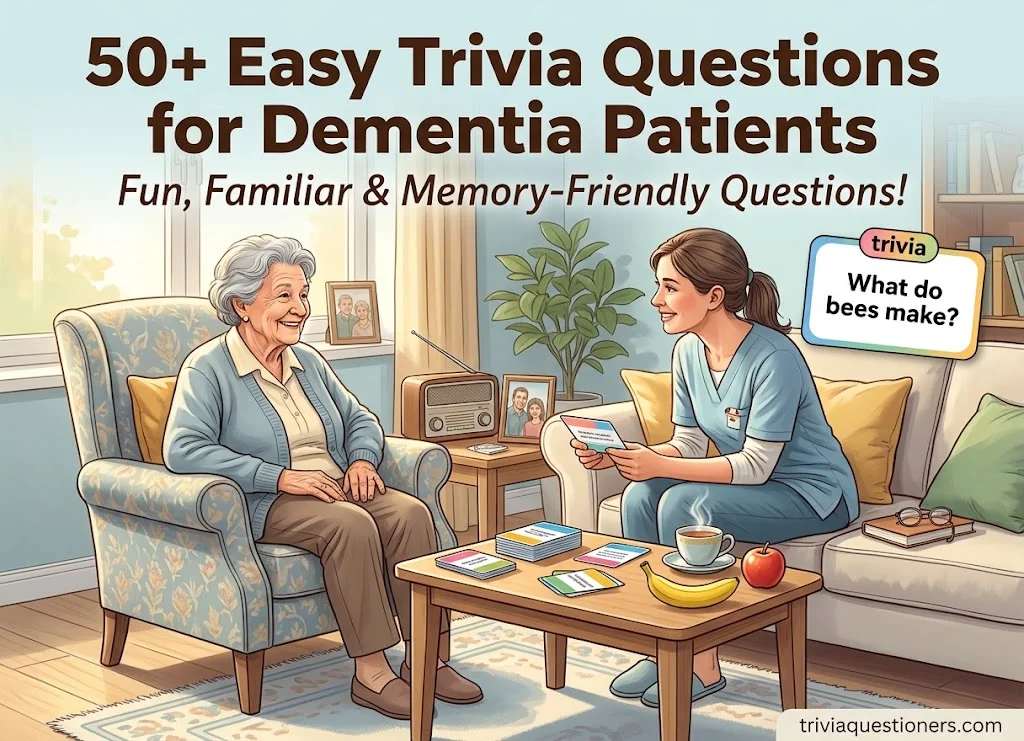
About 7 million Americans age 65 and older live with Alzheimer’s dementia, and many families look for kind, simple ways to connect. Easy trivia questions for dementia patients can do that. A familiar song or old TV show often brings back a smile and a story.
Below are 55 gentle trivia questions with answers, built around long-term memory, which often stays strong. Ask one at a time, give clues, and cheer every try. Trivia is a fun activity, not a treatment, so ask a doctor or memory care specialist what suits your loved one.
Table of Contents
Easy Everyday Trivia Questions for Dementia Patients
Everyday questions about familiar foods, animals, and household objects feel safe and easy. They suit early and middle stages well and help build confidence.
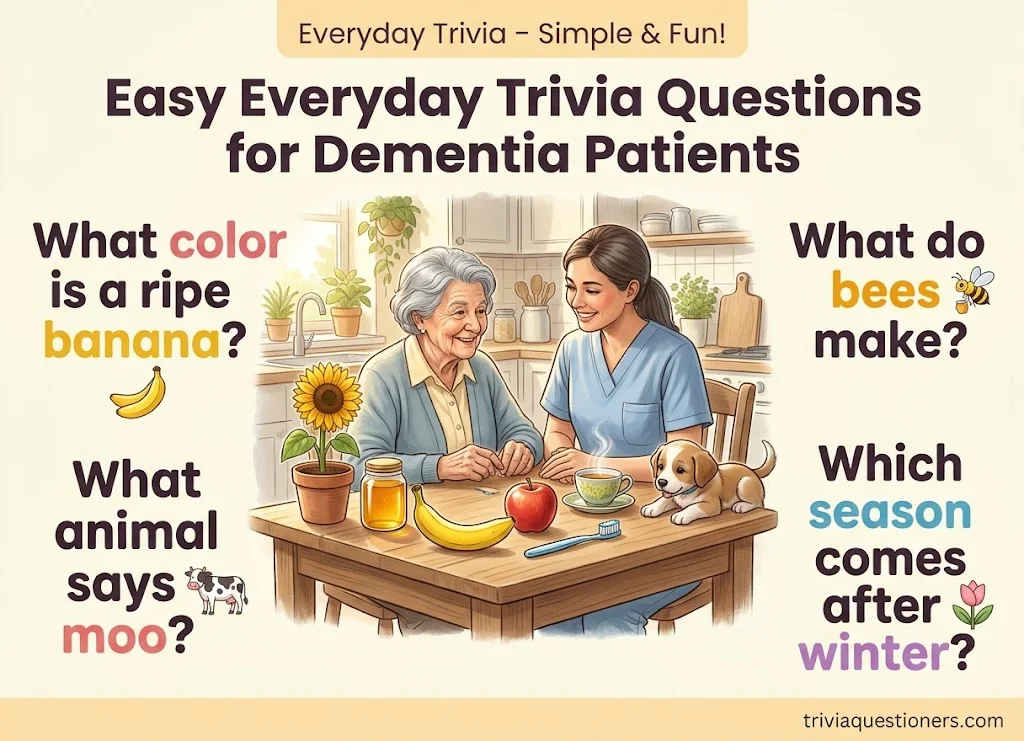
- What color is a ripe banana? Answer: Yellow
- What do bees make? Answer: Honey
- What animal says “moo”? Answer: A cow
- What do you use to brush your teeth? Answer: A toothbrush
- Which season comes after winter? Answer: Spring
- What color is the sky on a sunny day? Answer: Blue
- What do chickens lay? Answer: Eggs
- Which fruit keeps the doctor away, as the saying goes? Answer: An apple
- What do we call frozen water? Answer: Ice
- What do you wear on your feet? Answer: Shoes or socks
- Which kitchen appliance keeps food cold? Answer: A refrigerator
- What do we call a baby dog? Answer: A puppy
- Which tall yellow flower turns toward the sun? Answer: A sunflower
- Which appliance makes toast? Answer: A toaster
- What do you wear on your wrist to tell time? Answer: A watch
- What is the main ingredient in pumpkin pie? Answer: Pumpkin
- What sweet treat do people often eat on birthdays? Answer: Cake
- Which animal is called man’s best friend? Answer: A dog
A quick tip: sit side by side, turn off the TV, and pick a time of day when your loved one feels most alert. Mornings often work best.
Looking for more age-appropriate ways to keep young minds curious and engaged? Explore these fun trivia questions for 13-year-olds packed with interesting facts, brain-teasing challenges, and entertaining answers that make learning enjoyable for teens.
Music, Movie, and TV Trivia for Seniors with Dementia
Music and classic entertainment are powerful memory cues. The Alzheimer’s Association notes that familiar music can reach people even when words fade.
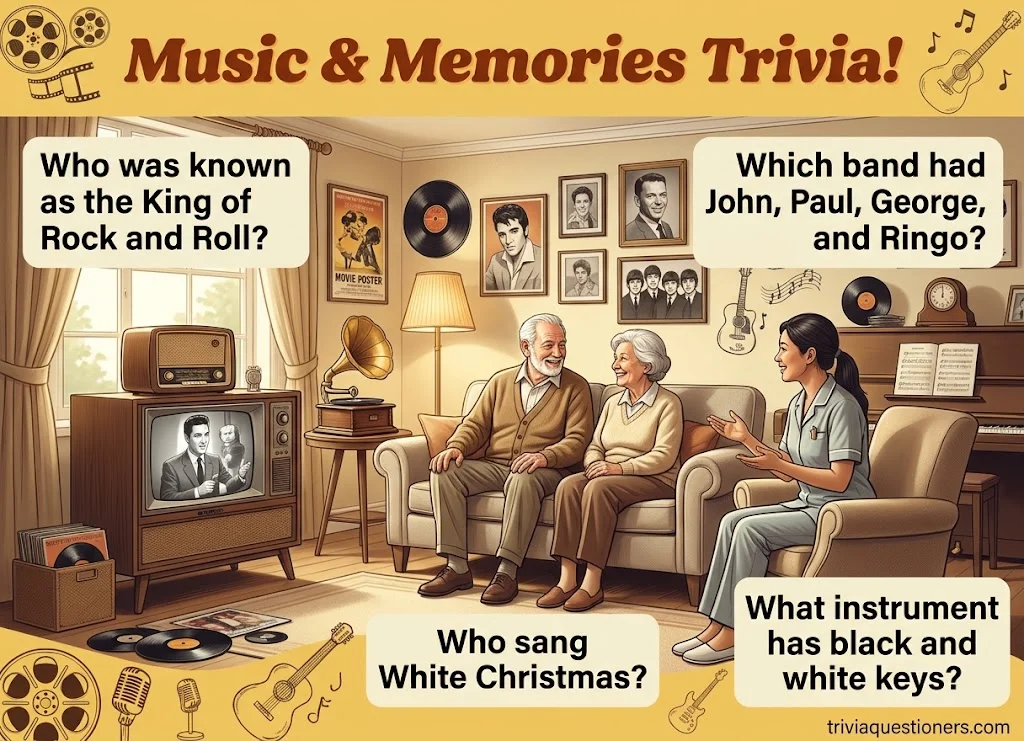
- Who was known as the “King of Rock and Roll”? Answer: Elvis Presley
- Which singer was nicknamed “Ol’ Blue Eyes”? Answer: Frank Sinatra
- Who sang “White Christmas”? Answer: Bing Crosby
- Who was called the “Queen of Soul”? Answer: Aretha Franklin
- Which band had John, Paul, George, and Ringo? Answer: The Beatles
- Who sang “What a Wonderful World”? Answer: Louis Armstrong
- Which singer was called “The Man in Black”? Answer: Johnny Cash
- Which instrument has black and white keys? Answer: The piano
- Which dance did Chubby Checker make famous? Answer: The Twist
- Who played Dorothy in The Wizard of Oz? Answer: Judy Garland
- What was the name of Dorothy’s little dog? Answer: Toto
- Who starred in the TV show I Love Lucy? Answer: Lucille Ball
- What town was home to The Andy Griffith Show? Answer: Mayberry
- Which TV show was set in an army hospital during the Korean War? Answer: M*A*S*H
- Which western TV show followed the Cartwright family? Answer: Bonanza
- Which famous collie starred on TV and in movies? Answer: Lassie
- Which movie nanny flew in with an umbrella? Answer: Mary Poppins
- Which actress starred in Breakfast at Tiffany’s? Answer: Audrey Hepburn
If a name won’t come, hum the tune or play the song. Then ask, “Did you like this one?” The story matters more than the answer.
History, Riddles, and Finish-the-Phrase Dementia Trivia
Well-known historical events and familiar sayings are easier than dates and facts. Finish-the-phrase and riddle questions need no reading, so they also work in the late stage.
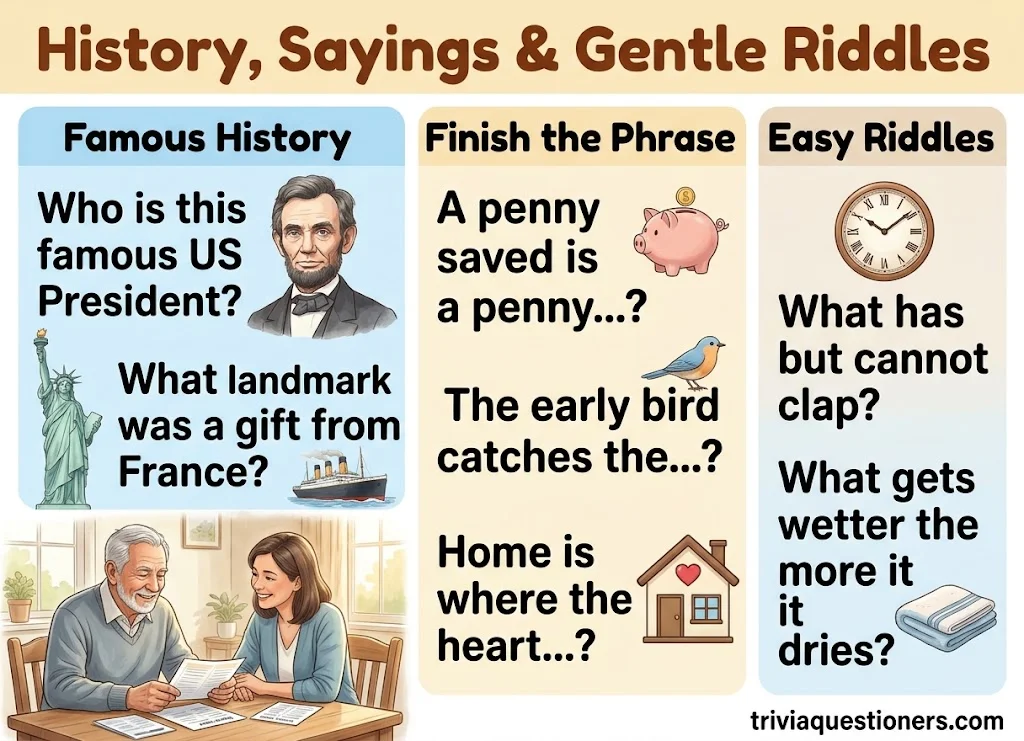
- Who was the first U.S. president? Answer: George Washington
- Who was the first person to walk on the Moon? Answer: Neil Armstrong
- Which ship sank after hitting an iceberg in 1912? Answer: The Titanic
- Which country gave the Statue of Liberty to the United States? Answer: France
- Who gave the “I Have a Dream” speech? Answer: Martin Luther King Jr.
- In which year did World War II end? Answer: 1945
- Whose face is on the U.S. penny? Answer: Abraham Lincoln
- Which famous 1969 music festival took place in New York? Answer: Woodstock
- Finish the saying: “A penny saved is a penny…” Answer: Earned
- Finish the saying: “The early bird catches the…” Answer: Worm
- Finish the saying: “Home is where the…” Answer: Heart is
- Finish the saying: “Actions speak louder than…” Answer: Words
- Finish the saying: “Birds of a feather…” Answer: Flock together
- Finish the saying: “Every cloud has a silver…” Answer: Lining
- What has hands but cannot clap? Answer: A clock
- What has one eye but cannot see? Answer: A needle
- What gets wetter the more it dries? Answer: A towel
- What goes up but never comes down? Answer: Your age
- What has a bed but never sleeps? Answer: A river
For harder moments, offer two or three choices, such as “Was it Elvis or Frank Sinatra?” This lowers pressure. The National Institute on Aging also advises adapting activities to the person’s abilities.
FAQs
What are the best trivia questions for dementia patients?
The best ones are short, familiar, and tied to the past. Think classic music, old TV shows, foods, animals, and everyday objects. They rely on long-term memory, so people can answer with confidence.
Should I correct a wrong answer during dementia trivia?
No. Validation matters more than accuracy. Smile and say, “That’s a good one. Tell me more.” This keeps the mood warm and protects their dignity.
How do I adapt trivia for different stages of dementia?
In the early stage, ask open questions that invite stories. In the middle stage, use multiple-choice options. In the late stage, use yes/no questions, music, or photos.
How long should a dementia trivia session last?
Aim for 10 to 20 minutes. Watch for signs of frustration, such as fidgeting, silence, or looking away. Take a break or switch to a favorite song.
Can trivia help someone with dementia?
Trivia is not a treatment. But it can lift mood, encourage social connection, and give a sense of success. Check with a doctor or memory care specialist first.
Conclusion
Easy trivia for dementia patients is about connection, not scores. Pick familiar topics, move slowly, and offer gentle clues. If a question falls flat, skip it or play a favorite song. A shared laugh or a story from long ago is the real prize.

William Vicky is the lead writer and trivia curator at Trivia Questioners, with a passion for uncovering fascinating facts across history, science, pop culture, and general knowledge. He loves crafting questions that challenge and delight readers of all ages.