Biology trivia questions are a fast way to test what you know about cells, DNA, animals, and the human body. This list has 100 numbered biology trivia questions and answers, ranked from easy to hard.
Each answer has a short fact, so you learn as you play. Use it for class, family game night, or a pub quiz.
Table of Contents
Easy Biology Trivia Questions and Answers
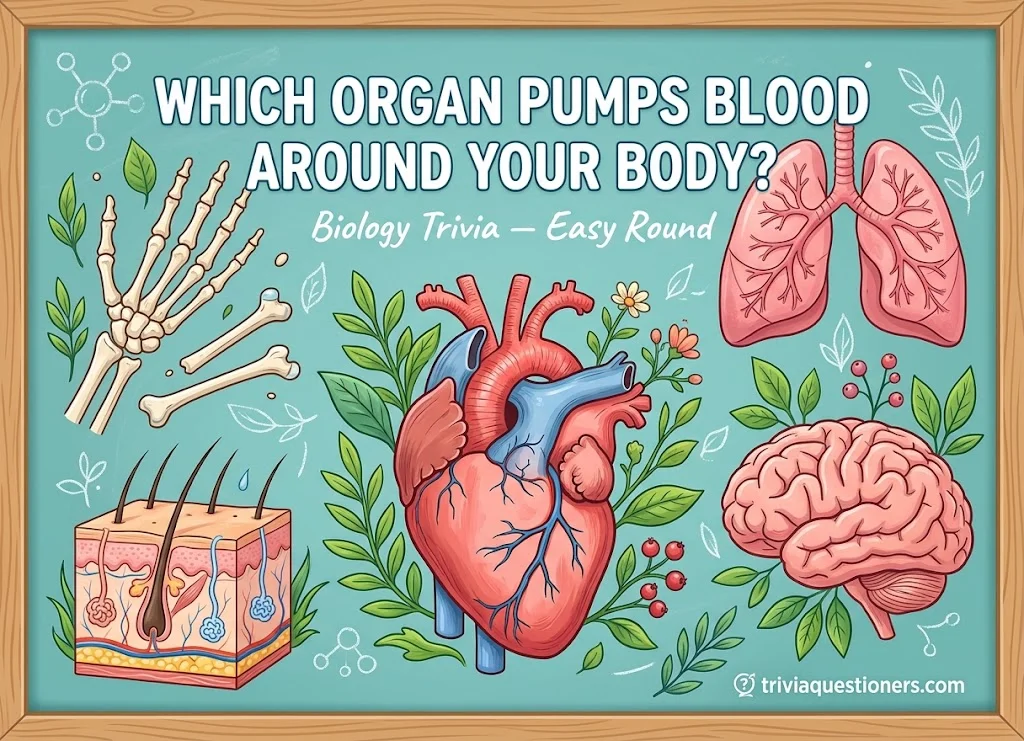
These biology easy trivia questions suit kids, beginners, and warm-up rounds. Read each question, then check the answer.
- Which organ pumps blood around your body?
Answer: The heart. It beats about 100,000 times a day. - What is the basic unit of life?
Answer: The cell. Robert Hooke gave it that name in 1665. - How many bones does an adult human have?
Answer: 206. Babies have about 300, but many fuse as they grow. - Which gas do plants release during photosynthesis?
Answer: Oxygen. - What green pigment helps plants capture sunlight?
Answer: Chlorophyll. - True or false: A spider is an insect.
Answer: False. Spiders have eight legs, so they are arachnids. - How many legs does an insect have?
Answer: Six. - What is the largest organ in the human body?
Answer: The skin. - What do we call animals that eat only plants?
Answer: Herbivores. - What do we call animals that eat both plants and meat?
Answer: Omnivores. - Which mammal is capable of true flight?
Answer: The bat. - How many hearts does an octopus have?
Answer: Three. - How do honeybees tell hive mates where food is?
Answer: With the waggle dance. - What color is a polar bear’s skin?
Answer: Black. Its fur only looks white. - Which organs take in oxygen when you breathe?
Answer: The lungs. - What is the hard outer layer of a tooth called?
Answer: Enamel. It is the hardest substance in the body. - Which molecule carries an organism’s genetic instructions?
Answer: DNA. - What is a baby frog called?
Answer: A tadpole. - What is the change from caterpillar to butterfly called?
Answer: Metamorphosis. - Which blood cells carry oxygen?
Answer: Red blood cells. - What is the study of plants called?
Answer: Botany. - What is the study of animals called?
Answer: Zoology. - Which gas do humans breathe out?
Answer: Carbon dioxide. - Which tube carries food from your mouth to your stomach?
Answer: The esophagus. - True or false: Whales are fish.
Answer: False. Whales are mammals. They breathe air and nurse their young. - What do plant roots absorb from the soil?
Answer: Water and minerals. - What is the scientific name for the tailbone?
Answer: The coccyx. - What is the largest animal that has ever lived?
Answer: The blue whale. - Which organ controls thinking, memory, and movement?
Answer: The brain. - What do we call animals without a backbone?
Answer: Invertebrates. - What is the scientific name for the kneecap?
Answer: The patella. - What is normal human body temperature?
Answer: About 98.6°F (37°C). - Which part of a cell acts as its control center?
Answer: The nucleus. - Which bone protects the brain?
Answer: The skull, or cranium. - Which sense organ has a lens and a pupil?
Answer: The eye.
Must Visit: 125+ Fun Road Trip Trivia Questions and Answers for Any Drive
Medium Biology Trivia Questions and Answers
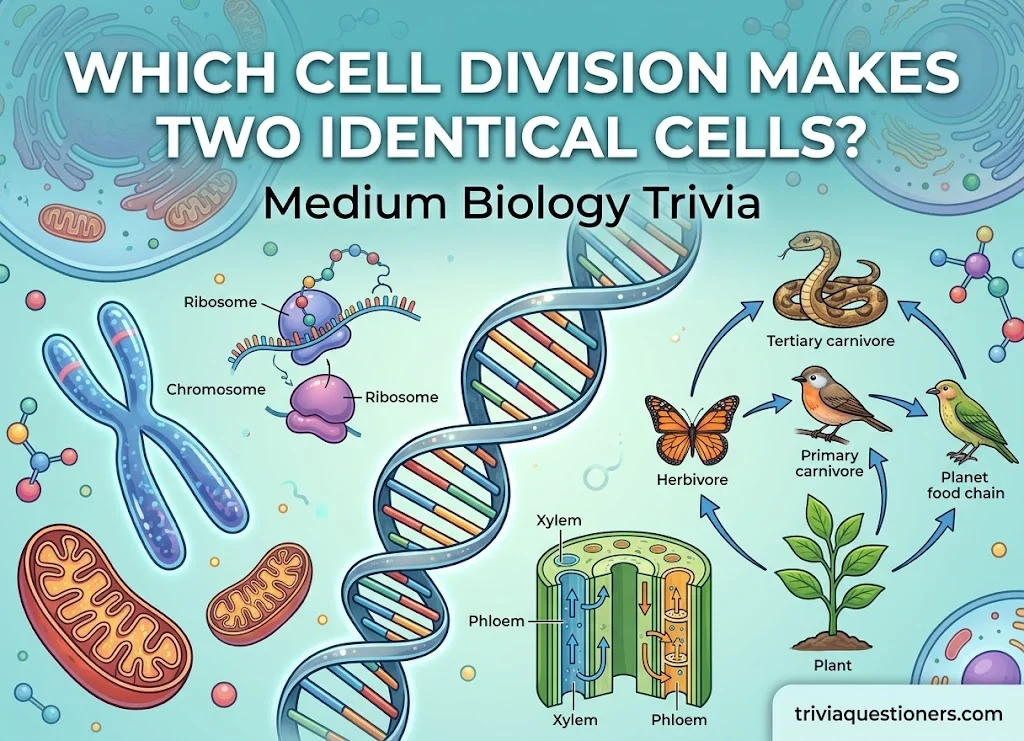
Here are the biology best trivia questions for students and quiz nights. They cover genetics, cell parts, ecosystems, and microbes.
- Which organelle makes most of a cell’s energy?
Answer: The mitochondrion. Its energy molecule is called ATP. - Who is called the “father of genetics”?
Answer: Gregor Mendel. He studied pea plants. - Who proposed evolution by natural selection?
Answer: Charles Darwin. - How many chromosomes are in a typical human cell?
Answer: 46, arranged in 23 pairs. - What are the four bases of DNA?
Answer: Adenine, thymine, cytosine, and guanine. - Which cell division makes two identical cells?
Answer: Mitosis. - Which cell division makes four sex cells with half the chromosomes?
Answer: Meiosis. - What do we call an organism’s observable traits?
Answer: Its phenotype. Eye color is one example. - What is a different version of the same gene called?
Answer: An allele. - Which plant tissue carries water from roots to leaves?
Answer: Xylem. - Which plant tissue carries sugars from leaves to the rest of the plant?
Answer: Phloem. - Which organelle builds proteins?
Answer: The ribosome. - Which organelle is called the “post office” of the cell?
Answer: The Golgi apparatus. It sorts and ships proteins. - Which iron-rich protein in red blood cells carries oxygen?
Answer: Hemoglobin. - Which part of the brain controls balance and coordination?
Answer: The cerebellum. - What are the three tiny bones of the middle ear?
Answer: The malleus, incus, and stapes. The stapes is the smallest bone in the body. - Who discovered penicillin?
Answer: Alexander Fleming, in 1928. - Which scientist named the “cell” after looking at cork?
Answer: Robert Hooke. National Geographic explains the story. - Which muscle drives breathing by moving up and down under the lungs?
Answer: The diaphragm. - What do we call all members of one species living in one area?
Answer: A population. - What is a partnership where both species benefit?
Answer: Mutualism. A clownfish and a sea anemone are one example. - What is an animal at the top of the food chain called?
Answer: An apex predator. - What do we call a map of many connected food chains?
Answer: A food web. - What tiny animals build coral reefs?
Answer: Coral polyps. - Which jellyfish can return to a young stage?
Answer: Turritopsis dohrnii, the “immortal jellyfish.” - Which tiny agent needs a host cell to reproduce?
Answer: A virus. - True or false: Antibiotics kill viruses.
Answer: False. They work on bacteria only. - Which fungus makes bread rise?
Answer: Yeast. - What is the study of fungi called?
Answer: Mycology. - Which vitamin does your skin make in sunlight?
Answer: Vitamin D. - Which organ makes bile?
Answer: The liver. The gallbladder stores it. - Which organs filter blood and make urine?
Answer: The kidneys. - What is the movement of water across a semipermeable membrane called?
Answer: Osmosis. - What is a plant that lives for more than two years called?
Answer: A perennial. - Which vertebrate may live the longest?
Answer: The Greenland shark. Estimates run from about 250 to over 400 years.
Hard Biology Trivia Questions and Answers
These biology hard trivia questions are for advanced students and trivia champions. Expect molecular biology, microbes, and famous scientists.
- Which base replaces thymine in RNA?
Answer: Uracil. - What is the full set of chromosomes in a cell, as seen under a microscope, called?
Answer: A karyotype. - Which energy-releasing cycle is named after Hans Krebs?
Answer: The Krebs cycle, also called the citric acid cycle. - What do we call reactions that build molecules using energy?
Answer: Anabolic reactions. Reactions that break molecules down are catabolic. - Who won the 2016 Nobel Prize for work on autophagy?
Answer: Yoshinori Ohsumi. See the Nobel Prize announcement. - Which process moves DNA between bacteria that are not parent and offspring?
Answer: Horizontal gene transfer. It helps spread antibiotic resistance. - Which misfolded proteins cause diseases like Creutzfeldt–Jakob disease?
Answer: Prions. - What is the protein shell around a virus’s genome called?
Answer: A capsid. - Which lab stain sorts bacteria into two groups by cell wall type?
Answer: The Gram stain. - Which proteins does DNA wrap around inside the nucleus?
Answer: Histones. - What is a group of genes controlled by one promoter called?
Answer: An operon. - Which domain of life includes many extremophiles and is neither bacteria nor eukaryote?
Answer: Archaea. - What do we call organisms that thrive in very hot places?
Answer: Thermophiles. - Who first saw bacteria under a microscope?
Answer: Antonie van Leeuwenhoek. - Which German doctor created famous rules for linking a germ to a disease?
Answer: Robert Koch. They are called Koch’s postulates. - Who created the square diagram that predicts genetic crosses?
Answer: Reginald Punnett. - Which hormone triggers contractions during childbirth?
Answer: Oxytocin. - Which hormone helps control your sleep-wake cycle?
Answer: Melatonin. - Which part of the human eye has no blood vessels?
Answer: The cornea. - Which glowing protein, first found in a jellyfish, is used as a lab marker?
Answer: Green fluorescent protein (GFP). - Roughly how big is the eye of a colossal squid?
Answer: About the size of a soccer ball, according to Te Papa. - Which tiny animal can survive the vacuum of space?
Answer: The tardigrade, or water bear. - What is the body’s extreme, life-threatening response to infection called?
Answer: Sepsis. - Which enzyme makes fireflies glow?
Answer: Luciferase. - What do we call animals that get body heat from their surroundings?
Answer: Ectotherms. - What is a group made of a common ancestor and all its descendants called?
Answer: A clade. - What are the tiny hair-like structures that move fluid or cells?
Answer: Cilia. - What small circular piece of DNA is used in genetic engineering?
Answer: A plasmid. - What is the process of a cell wrapping its membrane around a particle to bring it in?
Answer: Endocytosis. - Which theory says mitochondria came from ancient bacteria?
Answer: The endosymbiotic theory, made famous by Lynn Margulis.
Why Biology Trivia Question Boost Science Knowledge
Trivia works because of active recall. Pulling an answer from memory makes it stick better than rereading notes.
Short, fun biology trivia questions also make science feel light. That helps students who find textbooks heavy.
Some popular “facts” are only half true. You often hear that the Amazon makes 20% of Earth’s oxygen. Scientists call this a myth, because the forest uses almost as much oxygen as it makes.
A quick tip for hosts: plan three rounds by difficulty, give one point per answer, and keep a tiebreaker ready. Try “How many bones does an adult human have?”
FAQs
What are some biology fun trivia questions for students?
Try animal and body questions, like “How many hearts does an octopus have?” or “Which mammal can truly fly?” They are short, surprising, and easy to remember. Questions 11 to 14 and 60 are good starters.
What are the best biology trivia questions for a quiz?
The best ones mix difficulty, topics, and formats. Use a few true or false items, some short-answer items, and one or two hard closers. Questions 36 to 70 fit most quiz nights.
How can biology trivia questions help improve science knowledge?
They build recall. Answering from memory strengthens learning, and the short facts add context. Repeating a quiz over several days helps facts move into long-term memory.
What are some easy biology trivia questions for kids and beginners?
Start with Questions 1 to 35. They cover the heart, bones, plants, and animal basics. For example: “What is the largest organ in the human body?” The answer is the skin.
Where can I find challenging biology trivia with answers?
Start with Questions 71 to 100 above. For more, check school textbooks, university biology sites, and trusted trivia platforms. Always confirm answers with a reliable source.
Conclusion
You now have 100 biology trivia questions and answers for every level. Start easy, move up, and share the list with a friend or class.

William Vicky is the lead writer and trivia curator at Trivia Questioners, with a passion for uncovering fascinating facts across history, science, pop culture, and general knowledge. He loves crafting questions that challenge and delight readers of all ages.