Some space trivia questions look easy but trick almost everyone. Venus is hotter than Mercury. The Moon has no true “dark side.” Even NASA fans miss a few of these.
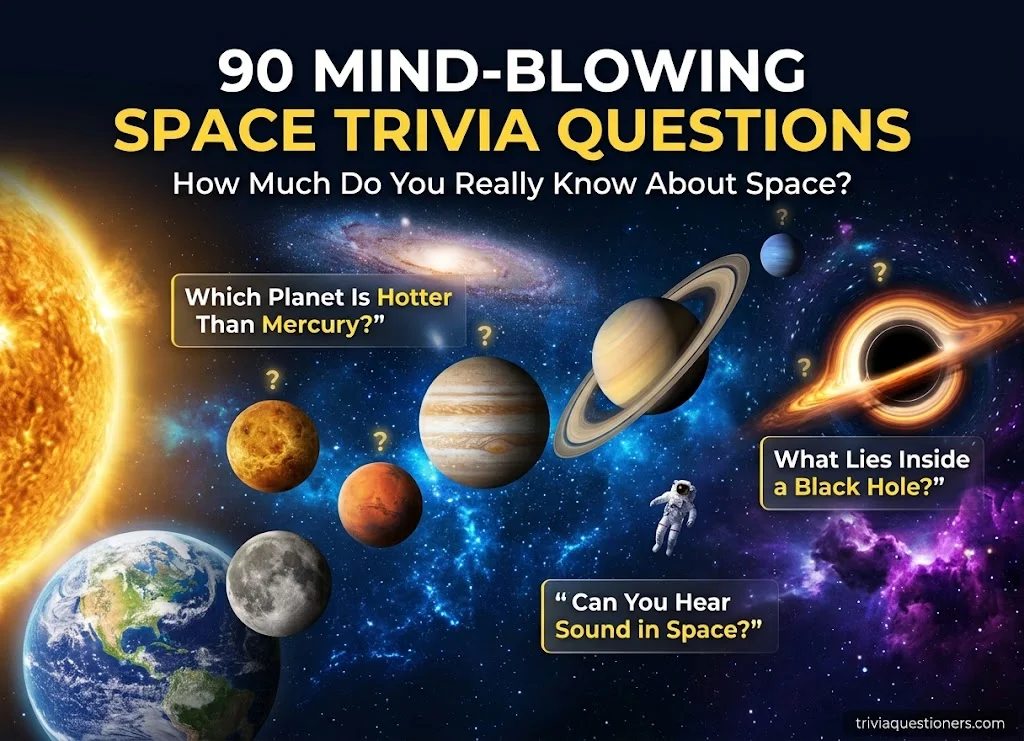
Here are 90 space trivia questions and answers for kids and adults. They cover planets, stars, black holes, and NASA missions. Guess first, then check the answer.
Table of Contents
Space Trivia Questions About Planets, the Solar System, and the Moon
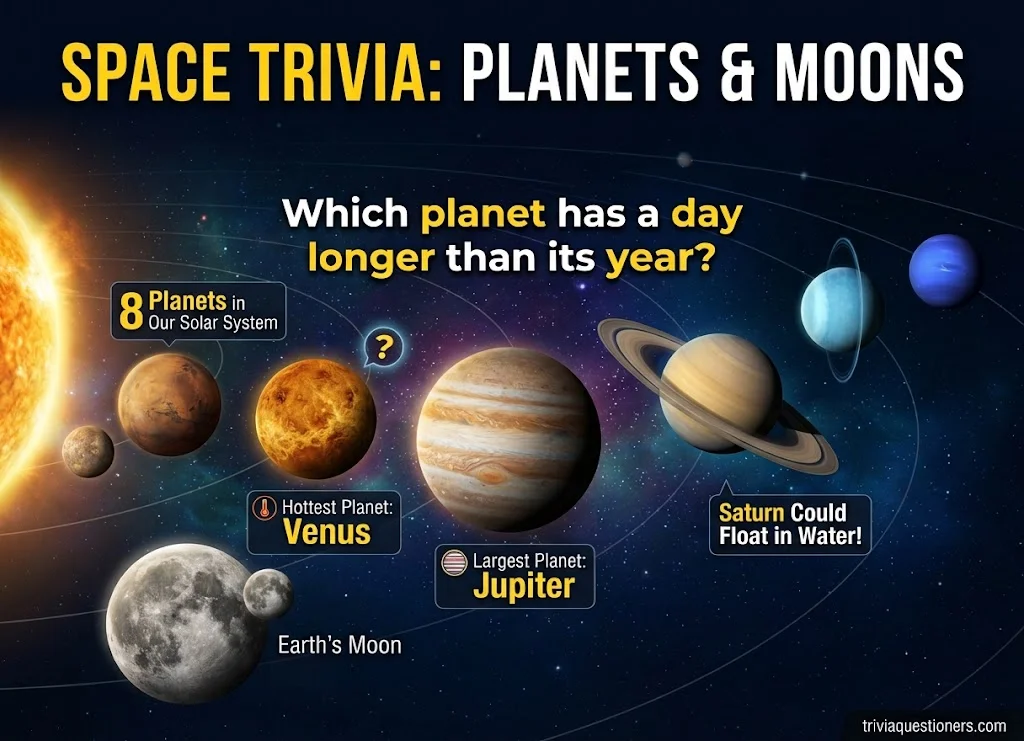
Start with these easy and hard space trivia questions about our cosmic neighborhood. Several answers fix common myths.
- How many planets are in our solar system? Eight. Pluto became a dwarf planet in 2006.
- Which planet is the hottest? Venus, at about 869°F (465°C), says NASA. Its thick carbon dioxide air traps heat in a runaway greenhouse effect. That is why it beats even Mercury.
- Which planet has a day longer than its year? Venus. It spins once every 243 Earth days but circles the Sun in about 225.
- What is the smallest planet? Mercury. It is only a bit larger than Earth’s Moon.
- Which planet spins on its side? Uranus. Its axial tilt is about 98 degrees, likely from an ancient crash.
- Which planet would float in water? Saturn. Its average density is about 0.69 g/cm³, lower than water’s 1.0.
- What is the largest planet? Jupiter. More than 1,300 Earths could fit inside it.
- What is Jupiter’s Great Red Spot? A giant storm wider than Earth. Astronomers have tracked it for well over a century, and it is slowly shrinking.
- Where is the tallest volcano in the solar system? On Mars. Olympus Mons stands about 13.6 miles (22 km) high, nearly three times taller than Mount Everest.
- What is the largest canyon in the solar system? Valles Marineris on Mars. It stretches roughly 2,500 miles (4,000 km).
- Why is Mars called the Red Planet? Its dust is rich in iron oxide. That is rust.
- How many moons does Mars have? Two, Phobos and Deimos. Both are small and lumpy.
- Which planet has the most moons? Saturn, with 274 confirmed as of 2025. The count keeps rising as telescopes find smaller ones. Check NASA’s moon tracker for updates.
- What is the largest moon in the solar system? Ganymede, a moon of Jupiter. It is even bigger than Mercury.
- Which moon has a thick atmosphere? Titan, Saturn’s largest moon. It also has lakes of liquid methane.
- Which moon shoots water into space? Enceladus. It vents water vapor and ice from cracks near its south pole. That points to a hidden ocean.
- Why is Pluto not a planet? In 2006 the International Astronomical Union ruled that a planet must clear its orbit. Pluto shares its zone with many icy objects.
- Where is the asteroid belt? Between Mars and Jupiter.
- Is the asteroid belt a crowded field of rocks? No. Objects sit hundreds of thousands of miles apart. Spacecraft cross it with ease.
- What is the largest object in the asteroid belt? Ceres, a dwarf planet about 590 miles wide.
- What is the Kuiper Belt? A ring of icy bodies and dwarf planets beyond Neptune.
- What is the Oort Cloud? A far-off shell of icy objects that may surround the solar system. Some comets likely come from there.
- How long does sunlight take to reach Earth? About 8 minutes and 20 seconds.
- Is there a “dark side” of the Moon? No. There is a far side that never faces Earth. It gets as much sunlight as the near side.
- Why do we always see the same face of the Moon? Tidal locking. The Moon spins once for every trip around Earth.
- How far away is the Moon? About 239,000 miles (384,400 km) on average.
- Is the Moon moving closer to or farther from Earth? Farther, by about 1.5 inches (3.8 cm) a year. Lasers bounced off Apollo-era mirrors prove it.
- How did the Moon form? Most scientists back the giant impact theory. A Mars-sized body hit young Earth about 4.5 billion years ago.
- What causes a solar eclipse? The Moon slides between the Sun and Earth. In a lunar eclipse, Earth sits between the Sun and Moon.
- What causes Earth’s seasons? Earth’s 23.5-degree tilt, not its distance from the Sun.
Exploring the mysteries of space is a great way to spark curiosity and sharpen critical thinking, but there’s plenty more to discover beyond the stars. Keep the learning fun with these 7th grade trivia questions and answers, covering science, history, geography, and general knowledge to challenge middle school students.
Space Trivia Questions About Stars, Galaxies, and Black Holes
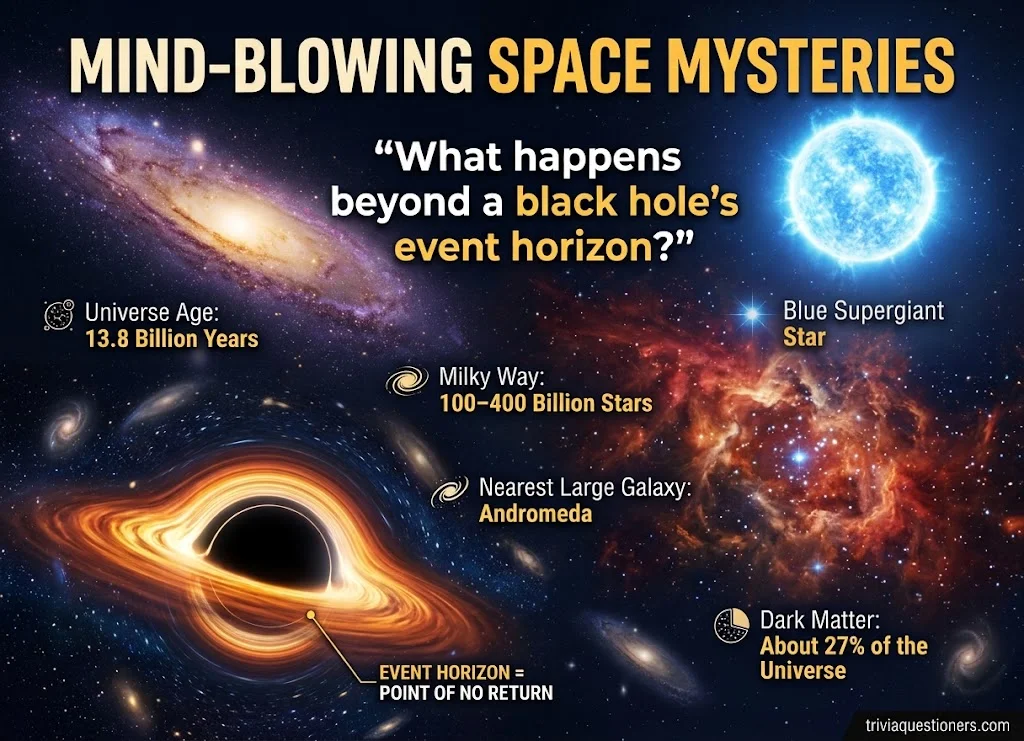
These challenging space trivia questions stretch from nearby stars to the edge of the observable universe.
- What is the closest star to Earth after the Sun? Proxima Centauri, about 4.24 light-years away.
- What is a light-year? A distance, not a time. It equals about 5.88 trillion miles (9.46 trillion km).
- What type of star is our Sun? A yellow dwarf, or G-type main-sequence star. It is truly white. Our air makes it look yellow.
- What color are the hottest stars? Blue or blue-white. Red stars burn the coolest.
- What is the most common star in the Milky Way? Red dwarfs. They make up about three-quarters of all stars.
- What is the brightest star in the night sky? Sirius, also called the Dog Star.
- What is the largest type of star? Red supergiants. Some are over a thousand times wider than the Sun.
- What is a nebula? A huge cloud of gas and dust. Many stars are born inside one.
- What is a supernova? The explosive death of a massive star.
- What is a pulsar? A fast-spinning neutron star that sends out beams of radiation, like a cosmic lighthouse.
- What is a white dwarf? The glowing core left behind by a Sun-like star.
- What is a black hole? A region where gravity is so strong that not even light escapes.
- What is the event horizon? The point of no return around a black hole.
- What sits at the center of the Milky Way? A supermassive black hole named Sagittarius A*. It holds about 4 million times the Sun’s mass.
- Who first photographed a black hole? The Event Horizon Telescope team, in 2019. The target sat in galaxy M87. They imaged Sagittarius A* in 2022.
- What shape is the Milky Way? A barred spiral about 100,000 light-years wide.
- How far is our Sun from the galactic center? About 26,000 light-years.
- What is the nearest large galaxy? Andromeda, about 2.5 million light-years away. It is heading toward us.
- How many stars are in the Milky Way? An estimated 100 to 400 billion.
- How many galaxies are in the observable universe? Estimates run from about 200 billion to 2 trillion. New telescope data keeps changing the number.
- How old is the universe? About 13.8 billion years.
- How big is the observable universe? About 93 billion light-years across.
- How much of the universe is dark matter? About 27%. We see its pull but never the matter itself.
- How much of the universe is dark energy? About 68%. Normal matter is only about 5%.
- What is the cosmic microwave background? The faint afterglow of the Big Bang. It was released about 380,000 years after the universe began.
- Why is the night sky dark? The universe has a finite age and is expanding. This puzzle is called Olbers’ paradox.
- Why is looking at distant galaxies like looking into the past? Light takes time to travel. We see far galaxies as they were long ago.
- What is an exoplanet? A planet that orbits another star. 51 Pegasi b, found in 1995, was the first around a Sun-like star. Its finders won the 2019 Nobel Prize in Physics.
- What is the habitable zone? The area around a star where liquid water could exist on a planet’s surface.
- What is a quasar? An extremely bright galactic core powered by a supermassive black hole.
NASA and Space Exploration Trivia Questions for Quiz Night
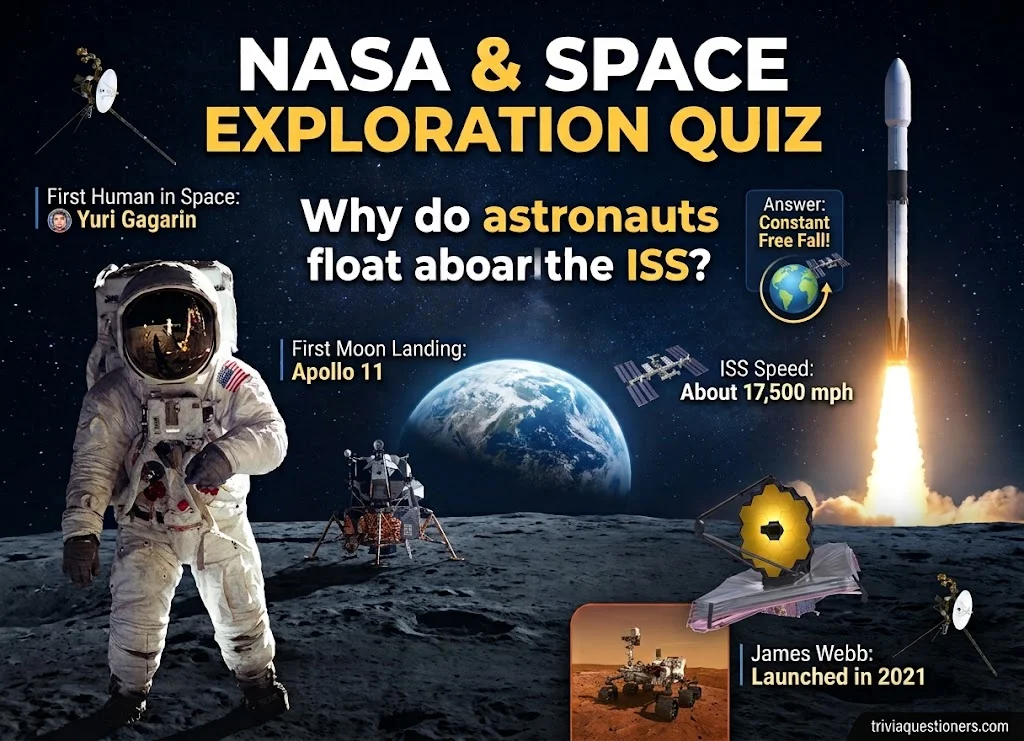
Here are the best NASA and space exploration trivia questions for a quiz night. They run from Sputnik to Mars rovers.
- What was the first artificial satellite? Sputnik 1, launched by the Soviet Union on October 4, 1957.
- Who was the first human in space? Yuri Gagarin, on April 12, 1961, aboard Vostok 1.
- Who was the first American in space? Alan Shepard, in 1961. His Freedom 7 flight lasted about 15 minutes.
- Who was the first woman in space? Valentina Tereshkova, in June 1963.
- Who made the first spacewalk? Alexei Leonov, in March 1965. His suit puffed up in the vacuum, and he had to let out air to fit back inside.
- Which animal first orbited Earth? Laika the dog, aboard Sputnik 2 in 1957.
- Who was the first person to walk on the Moon? Neil Armstrong, on July 20, 1969, during Apollo 11.
- How many people have walked on the Moon? Twelve. All were Americans in the Apollo program.
- Which mission was the last crewed Moon landing? Apollo 17, in December 1972.
- What went wrong on Apollo 13? An oxygen tank exploded in April 1970. The crew still made it home safely.
- What does NASA stand for? National Aeronautics and Space Administration. It began in 1958.
- What is NASA’s plan to return humans to the Moon? The Artemis program.
- Which Space Shuttle was lost in 1986? Challenger.
- What went wrong with the Hubble Space Telescope? Its main mirror had a tiny shape flaw after the 1990 launch. A repair mission in 1993 fixed it.
- Which telescope launched in December 2021? The James Webb Space Telescope. It sees infrared light and orbits about a million miles from Earth.
- Which spacecraft first landed on Mars and kept sending images? Viking 1, in July 1976.
- Which rover and helicopter landed on Mars in 2021? Perseverance and Ingenuity. Ingenuity made the first powered flight on another planet.
- Which spacecraft is now in interstellar space? Voyager 1. It launched in 1977 and crossed the heliopause in 2012.
- What is on the Voyager Golden Record? Greetings in 55 languages, music from around the world, and sounds of nature.
- Which spacecraft took the “Pale Blue Dot” photo? Voyager 1, in 1990. Carl Sagan asked for the shot.
- How fast does the International Space Station travel? About 17,500 mph. It circles Earth every 90 minutes, so crews see about 16 sunrises a day.
- Since when has the ISS had a crew nonstop? Since November 2000.
- Why do astronauts float on the ISS? They are in constant free fall. Gravity up there is still about 90% as strong as on the ground.
- Can you hear sound in space? No. Sound needs air or another medium to travel.
- Can you see the Great Wall of China from space with the naked eye? No. It is too narrow and matches the land around it.
- Do astronauts grow taller in space? Yes, by up to about 2 inches. The spine stretches without gravity. The gain fades after landing.
- What is a spacewalk officially called? An extravehicular activity, or EVA.
- What is the Russian word for astronaut? Cosmonaut.
- Where does space begin? At the Kármán line, about 62 miles (100 km) up. NASA and the U.S. Air Force award astronaut wings from 50 miles.
- How fast must a rocket go to escape Earth’s gravity? About 25,000 mph (11.2 km/s). This is escape velocity.
FAQs
What are some fun space trivia questions for kids and adults?
Try “Which planet has a day longer than its year?” (Venus) or “Can you hear sound in space?” (No). Kids enjoy planet colors, moons, and astronaut firsts. Adults enjoy myth-busters like the Moon’s “dark side.”
What are the most interesting space trivia questions with answers about planets and stars?
Top picks include Venus being hotter than Mercury and Saturn being lighter than water. The Sun looking yellow while truly white is another. Each answer surprises players, so it sticks.
What are some easy and hard space trivia questions to test your knowledge?
Easy: “How many planets are in the solar system?” (Eight). Hard: “What is Sagittarius A*?” (The Milky Way’s central black hole). Start easy and raise the difficulty each round.
What are the best NASA and space exploration trivia questions for a quiz night?
Ask about Apollo 11, Voyager 1, Hubble, and the James Webb Space Telescope. Add Perseverance and the Artemis program for fresh topics. Group questions by era to keep each round easy to follow.
What are some challenging space trivia questions about the universe, galaxies, and black holes?
Ask about the event horizon, the 27% dark matter share, and the cosmic microwave background. “Why is the night sky dark?” (Olbers’ paradox) stumps most players.
Conclusion
Space facts often defy common sense. That is why these questions trip people up. Share this list at your next quiz night or class, then see which of the 90 fooled your group most.

William Vicky is the lead writer and trivia curator at Trivia Questioners, with a passion for uncovering fascinating facts across history, science, pop culture, and general knowledge. He loves crafting questions that challenge and delight readers of all ages.