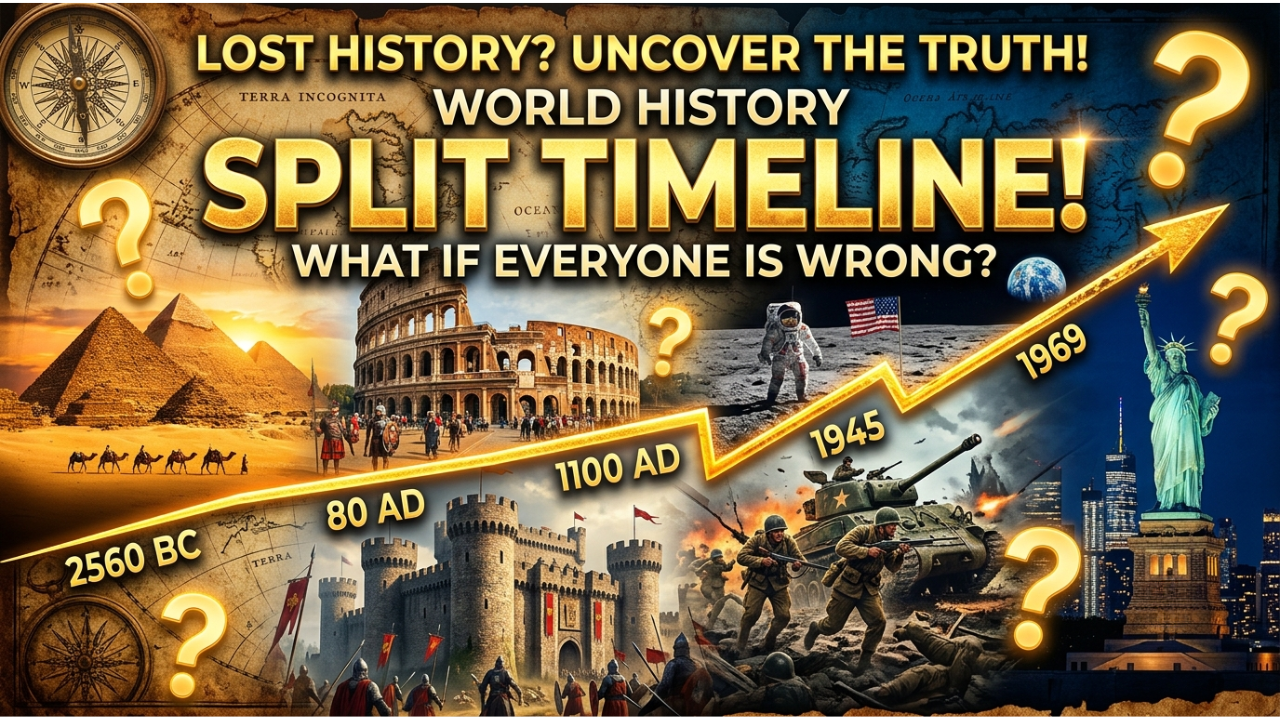
History isn’t just names and dates. It’s the reason your country, your city, and even your street name look the way they do. That’s what makes history trivia questions and answers so much fun to test — every question is a small window into a bigger story.
This guide gives you 150+ history trivia questions and answers, sorted from easy to hard, plus a fun bonus round. Whether you’re hosting trivia night, teaching a classroom, or just want to see how sharp your memory is, you’ll find real, checkable answers below — no guesswork, just facts.
Table of Contents
Easy History Trivia Questions and Answers

These easy history trivia questions cover the basics — names, dates, and events most people learn in school. They’re a great warm-up round for any quiz night or classroom activity.
Most visit: 300+ Friends TV Show Trivia Questions with Answers (2026)
- Q: Who was the first president of the United States? A: George Washington.
- Q: In which year did World War II end? A: 1945.
- Q: Which country gifted the Statue of Liberty to the United States? A: France.
- Q: What ship sank in 1912 after hitting an iceberg? A: The Titanic.
- Q: Who was the first person to walk on the moon? A: Neil Armstrong, in 1969.
- Q: Which wall divided East and West Berlin during the Cold War? A: The Berlin Wall.
- Q: Who painted the Mona Lisa? A: Leonardo da Vinci.
- Q: Which ancient civilization built the Great Pyramid of Giza? A: The ancient Egyptians.
- Q: What is the longest river in the world? A: The Nile River.
- Q: Who wrote the Declaration of Independence? A: Thomas Jefferson was the primary author.
- Q: Which war was fought between the North and South in the United States? A: The American Civil War (1861–1865).
- Q: Who was the King of England when the Magna Carta was signed? A: King John, in 1215.
- Q: What ancient Greek city-state was famous for its military training? A: Sparta.
- Q: Who led the civil rights movement and gave the “I Have a Dream” speech? A: Martin Luther King Jr.
- Q: What was the name of the ship that carried the Pilgrims to America? A: The Mayflower.
- Q: Which explorer is credited with reaching the Americas in 1492? A: Christopher Columbus.
- Q: What disease killed roughly a third of Europe’s population in the 1300s? A: The bubonic plague, also called the Black Death.
- Q: Who was the first female Prime Minister of the United Kingdom? A: Margaret Thatcher.
- Q: Which country is home to the Great Wall? A: China.
- Q: What event triggered the start of World War I? A: The assassination of Archduke Franz Ferdinand in Sarajevo.
- Q: Who was the 16th president of the United States? A: Abraham Lincoln.
- Q: What document freed enslaved people in Confederate states in 1863? A: The Emancipation Proclamation.
- Q: In which city is the Colosseum located? A: Rome, Italy.
- Q: Which amendment to the U.S. Constitution gave women the right to vote? A: The 19th Amendment.
- Q: Who was Cleopatra? A: The last active ruler of ancient Egypt’s Ptolemaic dynasty.
- Q: What was the name of the economic crisis that began in 1929? A: The Great Depression.
- Q: Who invented the printing press? A: Johannes Gutenberg.
- Q: What was the capital of the Byzantine Empire? A: Constantinople, now called Istanbul.
- Q: Who was the first emperor of Rome? A: Augustus.
- Q: What treaty officially ended World War I? A: The Treaty of Versailles.
- Q: Which country was first to send a human into space? A: The Soviet Union, with cosmonaut Yuri Gagarin in 1961.
- Q: What was the name of the U.S. program that developed the atomic bomb? A: The Manhattan Project.
- Q: Who was the first Black president of South Africa? A: Nelson Mandela.
- Q: What ancient trade route connected China to the Mediterranean? A: The Silk Road.
- Q: Which country was ruled by the Pharaohs? A: Ancient Egypt.
- Q: Who assassinated President Abraham Lincoln? A: John Wilkes Booth.
- Q: What was the name of the first English colony in North America? A: Jamestown, founded in 1607.
- Q: Who was the first woman to win a Nobel Prize? A: Marie Curie.
- Q: What continent is considered the birthplace of humanity? A: Africa.
- Q: Which country was formerly known as Persia? A: Iran, which officially adopted the name in 1935.
Medium History Trivia Questions and Answers

These medium history trivia questions dig a little deeper into ancient civilizations, medieval Europe, and world-changing events. They’re a good fit for readers who already know the basics and want a real challenge.
- Q: Who was the last pharaoh of ancient Egypt? A: Cleopatra VII.
- Q: What was the ancient Greek historian Herodotus known as? A: The “Father of History.”
- Q: Which Roman road connected Rome to southeastern Italy? A: The Appian Way.
- Q: Which ancient civilization is credited with inventing the wheel? A: The Sumerians of Mesopotamia.
- Q: What disease killed an estimated 20 million people at the end of World War I? A: The Spanish flu pandemic of 1918.
- Q: Which university is considered the oldest in continuous operation? A: The University of Bologna, founded in 1088.
- Q: Who was crowned Holy Roman Emperor by the Pope on Christmas Day in 800 AD? A: Charlemagne.
- Q: Which battle in 1066 changed the course of English history? A: The Battle of Hastings.
- Q: What was the name of the secret police in Nazi Germany? A: The Gestapo.
- Q: What policy did Mikhail Gorbachev introduce to reform the Soviet Union? A: Glasnost and perestroika.
- Q: Which president issued the Louisiana Purchase? A: Thomas Jefferson, in 1803.
- Q: What was the name of the 1947 plan to rebuild Western Europe after World War II? A: The Marshall Plan.
- Q: Who led French forces during the Hundred Years’ War as a teenager? A: Joan of Arc.
- Q: What system organized medieval European society around land and loyalty? A: Feudalism.
- Q: Which conference in 1945 planned the post-war division of Europe? A: The Yalta Conference.
- Q: Who was the first tsar of Russia? A: Ivan the Terrible.
- Q: What event in 1962 brought the U.S. and Soviet Union to the brink of nuclear war? A: The Cuban Missile Crisis.
- Q: Which African empire was known for the wealth of its ruler, Mansa Musa? A: The Mali Empire.
- Q: What was the capital of the Aztec Empire? A: Tenochtitlan.
- Q: Who was the philosopher that tutored Alexander the Great? A: Aristotle.
- Q: What scandal forced President Richard Nixon to resign in 1974? A: The Watergate scandal.
- Q: Which document, signed in 1215, limited the power of the English king? A: The Magna Carta.
- Q: What was the name of the ancient Mesopotamian legal code? A: The Code of Hammurabi, which contained 282 laws.
- Q: Who founded the Mongol Empire? A: Genghis Khan, in 1206.
- Q: Which African American woman refused to give up her bus seat in Montgomery, Alabama? A: Rosa Parks.
- Q: What was the primary export of the Potosí silver mines in colonial South America? A: Silver.
- Q: Which invention by Gutenberg changed how ideas spread across Europe? A: The printing press, invented around 1440.
- Q: What was the name of the first African American Supreme Court justice? A: Thurgood Marshall.
- Q: Who was known as the “Maid of Orleans”? A: Joan of Arc.
- Q: What network of secret routes helped enslaved people escape to freedom? A: The Underground Railroad.
- Q: Which empire controlled much of Spain during the medieval period? A: The Umayyad Caliphate, also called Al-Andalus.
- Q: Who wrote the 95 Theses that sparked the Protestant Reformation? A: Martin Luther, in 1517.
- Q: What ancient wonder stood in Alexandria, Egypt? A: The Lighthouse of Alexandria, also called the Pharos of Alexandria.
- Q: Which countries made up the Axis Powers in World War II? A: Germany, Italy, and Japan.
- Q: Who was the first woman elected to the U.S. Congress? A: Jeannette Rankin, in 1916.
- Q: What was the main goal of Japan’s Meiji Restoration? A: Rapid modernization and Westernization.
- Q: Which two rivers formed the heart of ancient Mesopotamia? A: The Tigris and the Euphrates.
- Q: Who was the last Tsar of Russia before the 1917 revolution? A: Nicholas II.
- Q: What was the name of the first successful vaccine, developed by Edward Jenner? A: The smallpox vaccine, developed in 1796.
- Q: Which trade network is most associated with spreading the Black Death to Europe? A: The Silk Road.
- Q: Who was the first African American to play Major League Baseball? A: Jackie Robinson, in 1947.
- Q: What was the name of the Allied invasion of Normandy in 1944? A: D-Day.
- Q: Which country was the first to grant women the right to vote nationally? A: New Zealand, in 1893.
- Q: What was the Berlin Airlift? A: A 1948–1949 effort by the U.S. and its allies to supply West Berlin by air after Soviet forces blocked land routes.
- Q: Who was the first person to circumnavigate the globe? A: Ferdinand Magellan’s expedition completed the voyage, though Magellan himself died before its end.
Hard History Trivia Questions and Answers

If you’re looking for the hardest history trivia questions, this is where things get tricky. These questions cover obscure rulers, forgotten treaties, and details that stump even serious history buffs.
- Q: What was the name of the medieval Islamic scholar who wrote The Canon of Medicine? A: Avicenna, also known as Ibn Sina.
- Q: Which Roman military formation involved soldiers locking shields above their heads? A: The testudo, or “tortoise” formation.
- Q: What was the name of the 1884 conference that formalized the European colonization of Africa? A: The Berlin Conference.
- Q: Which empire used the “Mita” labor system for public works? A: The Inca Empire.
- Q: What was the “Mandate of Heaven,” and where was it used? A: A political concept in ancient China that justified a ruler’s right to govern.
- Q: Which elite infantry units served the Ottoman Empire? A: The Janissaries.
- Q: What event is often called the first “total war”? A: World War I, due to its scale of civilian and military mobilization.
- Q: Who was the final ruler of the Assyrian Empire? A: Ashur-uballit II.
- Q: What was the primary cause of the Opium Wars between Britain and China? A: A trade dispute over Britain’s illegal opium sales in China.
- Q: Which dynasty sent Admiral Zheng He on major maritime expeditions? A: The Ming Dynasty.
- Q: What was the Defenestration of Prague, and what war did it spark? A: The 1618 incident where officials were thrown from a castle window, sparking the Thirty Years’ War.
- Q: Who is credited with developing the first known writing system, cuneiform? A: The Sumerians, around 3400 BCE.
- Q: What was the name of the political ideology followed by Benito Mussolini and Francisco Franco? A: Fascism.
- Q: Which two African nations avoided European colonization? A: Ethiopia and Liberia.
- Q: What was the “Congress of Vienna,” and why did it convene? A: An 1814–1815 meeting of European powers held to redraw the continent’s borders after the Napoleonic Wars.
- Q: Who was the first Roman emperor to convert to Christianity? A: Constantine the Great.
- Q: What was the “Green Revolution” of the 20th century primarily focused on? A: Increasing agricultural production through high-yield crop varieties.
- Q: Which South American civilization built an extensive road system without using the wheel? A: The Inca Empire.
- Q: What ancient religion did the prophet Zoroaster found? A: Zoroastrianism, in ancient Persia.
- Q: Which battle is widely seen as the turning point of the American Revolution? A: The Battle of Saratoga.
- Q: What was the name of the treaty that ended the American Revolutionary War? A: The Treaty of Paris, signed in 1783.
- Q: Who was the last active ruler of the Ptolemaic Kingdom of Egypt? A: Cleopatra VII.
- Q: What was the “Scramble for Africa”? A: The rapid colonization and division of the African continent by European powers in the late 19th century.
- Q: Which ancient Chinese philosophy emphasized harmony with nature? A: Taoism, also spelled Daoism.
- Q: What was the name of the medieval Islamic philosophical movement that tried to reconcile faith and reason? A: Islamic Scholasticism.
- Q: Who was the first European explorer believed to have reached North America, centuries before Columbus? A: Leif Erikson, around 1000 AD.
- Q: What was the outcome of the Council of Trent? A: It formalized the Catholic Counter-Reformation in response to Protestantism.
- Q: Which war began with the “War of the Golden Stool” in West Africa? A: A conflict between the British and the Ashanti Empire in 1900.
- Q: What was the primary language spoken in the Byzantine Empire? A: Greek.
- Q: Which explorer is credited with being the first European to see the Pacific Ocean? A: Vasco Núñez de Balboa, in 1513.
- Q: What was the “Xinhai Revolution,” and what did it end? A: The 1911–1912 revolution that ended more than two thousand years of dynastic rule in China.
- Q: Who is regarded as the founder of Western philosophy? A: Socrates.
- Q: What was the name of the currency used in colonial America before the U.S. dollar? A: Continental currency.
- Q: Which ancient civilization built the city of Uruk? A: The Sumerians.
- Q: What was the “Truman Doctrine,” and what was its purpose? A: A U.S. policy announced in 1947 aimed at containing the spread of communism.
- Q: Which medieval empire controlled North Africa and much of the Middle East under the Abbasid Caliphate? A: The Abbasid Caliphate itself, centered in Baghdad.
- Q: What was Operation Barbarossa? A: The code name for Nazi Germany’s 1941 invasion of the Soviet Union.
- Q: Who is credited with founding the Xia Dynasty in China? A: Yu the Great.
- Q: What was the name of the first artificial satellite launched into orbit? A: Sputnik 1, launched by the Soviet Union in 1957.
- Q: Which document, written by Enlightenment thinker John Locke, influenced the idea of the “social contract”? A: Two Treatises of Government.
Fun History Trivia Questions and Answers

Not every piece of history trivia has to be serious. These fun history trivia questions work great for adults looking for surprising facts, and a handful are simple enough for kids to enjoy too.
- Q: Which Roman emperor supposedly made his horse a consul? A: Caligula.
- Q: What was the shortest war in recorded history? A: The Anglo-Zanzibar War of 1896, which lasted around 38 minutes.
- Q: What pet did President John Quincy Adams keep in the White House? A: An alligator.
- Q: What did ancient Romans reportedly tax? A: Urine, which was collected and used in industries like tanning and laundering.
- Q: Which U.S. president served the shortest term in office? A: William Henry Harrison, who served just 31 days in 1841.
- Q: What did Benjamin Franklin want as the national bird of the United States? A: The wild turkey.
- Q: What was the original color of the Statue of Liberty? A: Copper brown, before it oxidized into its current green color.
- Q: How many U.S. presidents have been assassinated while in office? A: Four — Abraham Lincoln, James A. Garfield, William McKinley, and John F. Kennedy.
- Q: What card hand was Wild Bill Hickok holding when he was killed? A: A pair of aces and eights, later nicknamed the “Dead Man’s Hand.”
- Q: What was the original purpose of high heels? A: Persian cavalry wore them to help secure their feet in stirrups.
- Q: Which ancient civilization is credited with the first recorded joke? A: The Sumerians.
- Q: How many months were in the original Roman calendar? A: Ten.
- Q: What year did the seven-day week become standard, and who decreed it? A: 321 AD, decreed by Roman Emperor Constantine.
- Q: Who is considered the first American serial killer? A: H.H. Holmes.
- Q: What was carved into a tree on Roanoke Island in 1590, linked to the lost colony’s disappearance? A: The word “Croatoan.”
- Q: Which country is home to the world’s oldest known university? A: Morocco, home to the University of Al Quaraouiyine, founded in 859 AD.
- Q: What animal did the Soviet Union send into orbit before any human? A: A dog named Laika, in 1957.
- Q: What was unusual about how the Titanic’s lifeboats were used? A: The ship carried enough lifeboats for only about half its passengers and crew.
- Q: What nickname was given to Attila, leader of the Huns? A: “The Scourge of God.”
- Q: Which historical figure died after apparently eating too many cherries and drinking cold milk? A: U.S. President Zachary Taylor, though the exact cause is still debated.
- Q: What was Napoleon Bonaparte’s height, contrary to popular myth? A: About 5 feet 7 inches, average for a Frenchman of his era — the “short Napoleon” myth came from a mix-up in French and English measurement units.
- Q: What incendiary weapon did the Byzantine navy use to devastating effect? A: Greek fire.
- Q: Which queen of ancient Egypt is believed to have ruled disguised in male royal dress? A: Hatshepsut.
- Q: What was the name of the first computer built for general-purpose use? A: ENIAC, completed in 1945.
- Q: How many rules were written in the Code of Hammurabi? A: 282.
How to Use These History Trivia Questions

You don’t need special tools to run a great history trivia round — just a plan.
For trivia night, mix difficulty levels instead of running straight through. Open with easy questions to build confidence, then work up to medium and hard rounds. This keeps both casual players and serious history buffs engaged.
For classrooms, these questions work well as a warm-up, a review game before a test, or a quick exit-ticket check at the end of a lesson. Teachers often find that mixing categories — ancient, medieval, U.S. history, and modern — keeps students from tuning out.
For families or game night, the fun round is the easiest entry point, especially for younger players or anyone new to trivia. Print the questions on index cards, or read them aloud and let players buzz in.
If you want a digital format, many free quiz-building tools let you turn a list like this into an interactive game with a leaderboard and timer, which adds energy to a live event.
FAQs
What are the best history trivia questions?
The best history trivia questions balance a clear answer with real learning value. They should test something specific — a name, date, or event — while still teaching the reader something new.
What are some easy history trivia questions?
Easy history trivia questions cover widely known facts, such as who the first U.S. president was, when World War II ended, or who painted the Mona Lisa. These work well as warm-up questions before moving into harder rounds.
What are the hardest history trivia questions?
The hardest history trivia questions usually involve obscure rulers, exact dates of lesser-known treaties, or details from ancient and medieval history that go beyond general knowledge — things like the Defenestration of Prague or the Mita labor system of the Inca Empire.
What are fun history trivia questions for adults?
Fun history trivia questions for adults often focus on strange, surprising facts — like the shortest war in history, unusual laws from ancient Rome, or odd presidential pets. These add humor to a serious subject and keep a trivia night lively.
What are history trivia questions for kids?
History trivia questions for kids should use simple wording and cover well-known, age-appropriate topics — explorers, inventions, and famous figures like George Washington or the Wright brothers — without requiring exact dates or complex political context.
Conclusion
History trivia is more than a party game — it’s a fast way to connect with the past. With 150+ history trivia questions and answers spanning easy, medium, hard, and fun categories, you now have everything you need for a quiz night, classroom activity, or a solo test of your own knowledge. Pick a difficulty, gather your players, and see who really knows their history.

William Vicky is the lead writer and trivia curator at Trivia Questioners, with a passion for uncovering fascinating facts across history, science, pop culture, and general knowledge. He loves crafting questions that challenge and delight readers of all ages.