Science touches everything you do, from the coffee you brew to the phone in your hand. Yet most of us forget the small, strange facts behind it all. This list of science trivia questions with answers brings those facts back, one question at a time.
Whether you want easy science trivia for a family game night or hard science trivia questions to stump your smartest friend, this 2026 collection has over 200 questions across space, biology, chemistry, earth science, and the scientists who changed history. Grab a notepad and see how many you can answer before peeking.
Table of Contents
Easy Science Trivia Questions and Answers
These warm-up questions cover the basics of space, the human body, and everyday chemistry. They’re a great starting point if you’re new to science trivia questions and answers.
- What is the largest planet in our solar system? Jupiter
- What gas do humans need to breathe to survive? Oxygen
- What is the fastest land animal? The cheetah
- How many bones are in the adult human body? 206
- What is the chemical symbol for water? H₂O
- What planet is known as the Red Planet? Mars
- What organ pumps blood through the body? The heart
- What force pulls objects toward the Earth? Gravity
- What do you call an animal that eats only plants? An herbivore
- What is the closest star to Earth? The Sun
- How many colors are in a rainbow? Seven
- What is the study of weather called? Meteorology
- What is the smallest planet in our solar system? Mercury
- What part of the plant absorbs sunlight? The leaves
- What is the freezing point of water in Celsius? 0 degrees
- What organ filters waste from the blood? The kidneys
- What is the hardest natural substance on Earth? Diamond
- How many legs does a spider have? Eight
- What is the process plants use to make food from sunlight? Photosynthesis
- What is the largest organ in the human body? The skin
- What planet has the famous rings? Saturn
- What do bees make in a hive? Honey
- What is the boiling point of water in Fahrenheit? 212 degrees
- What gas do plants release during photosynthesis? Oxygen
- What do you call a scientist who studies rocks? A geologist
- How many chambers does the human heart have? Four
- What is the center of an atom called? The nucleus
- What is the only metal that stays liquid at room temperature? Mercury
- What natural event happens when tectonic plates shift suddenly? An earthquake
- What is the study of living things called? Biology
- What do you call baby frogs before they grow legs? Tadpoles
- What is the layer of gas surrounding Earth called? The atmosphere
- What organ helps you breathe? The lungs
- What force keeps the Moon orbiting Earth? Gravity
- What do you call a group of stars that forms a shape? A constellation
- What is the main gas that humans exhale? Carbon dioxide
- What is the study of insects called? Entomology
- How many planets are in our solar system? Eight
- What is the process of water turning into vapor called? Evaporation
- What is the powerhouse of the cell called? The mitochondria
Must Visit: 200+ Fun Pop Culture Trivia Questions and Answers for Every Fan
Hard Science Trivia Questions and Answers
This is where hard science trivia questions really test your limits. Each answer includes a short explanation, so you’ll walk away knowing a little more than you did before.
- What is the rarest naturally occurring element on Earth? Astatine. Scientists believe less than a gram exists in Earth’s crust at any given moment, since it decays almost as fast as it forms.
- What is the term for splitting an atomic nucleus? Fission, the reaction that powers nuclear plants by releasing massive amounts of energy.
- What is the term for joining two light atomic nuclei together? Fusion, the same process that powers the Sun.
- At what temperature are Celsius and Fahrenheit equal? Minus 40 degrees, the one point where both scales meet.
- What is dark matter? An invisible substance that doesn’t emit or reflect light but is detected through its gravitational pull. It’s estimated to make up roughly 27% of the universe, according to <a href=”https://science.nasa.gov/mission/hubble/science/dark-matter-dark-energy/” target=”_blank” rel=”noopener”>NASA</a>.
- What is the half-life of carbon-14? About 5,730 years, which is why it’s used to date ancient organic material.
- What is absolute zero in Celsius? Minus 273.15 degrees, the coldest temperature theoretically possible.
- What subatomic particles combine to form protons and neutrons? Quarks
- What is the Mohs scale used to measure? The hardness of minerals, from talc at 1 to diamond at 10.
- What is sublimation? The process where a solid changes directly into a gas without becoming liquid first, like dry ice.
- What is the deepest known point in Earth’s oceans? The Challenger Deep in the Mariana Trench, sitting about 36,000 feet below sea level.
- What planet spins on its side? Uranus, tilted at roughly 98 degrees, likely from an ancient collision.
- What is the Doppler Effect? The change in pitch or frequency of a wave caused by the motion of its source, like a siren changing tone as it passes.
- What is the speed of light in a vacuum? About 186,282 miles per second, the universal speed limit.
- What is the largest volcano in the solar system? Olympus Mons on Mars, roughly 2.5 times taller than Mount Everest.
- What is a Geiger counter used to detect? Ionizing radiation
- What is the newest confirmed element on the periodic table? Oganesson, added in 2016.
- What causes gravitational lensing? Massive objects, like galaxies, bending the light that passes near them, a phenomenon predicted by Einstein’s general relativity.
- What is the term for atoms of the same element with different atomic masses? Isotopes
- What law states that entropy never decreases in a closed system? The Second Law of Thermodynamics
- What is the rarest human blood type? Rh-null, sometimes called “golden blood” because so few people carry it.
- How long does it take sunlight to reach Earth? About 8 minutes and 20 seconds
- What is the strongest bite force among living animals? The saltwater crocodile, whose bite can exceed 3,700 pounds per square inch.
- What is Bernoulli’s Principle used to explain? How airplane wings generate lift as air moves faster over the curved top surface.
- What is the difference between weather and climate? Weather describes short-term atmospheric conditions, while climate describes long-term patterns over decades.
- What is a black hole’s event horizon? The boundary beyond which nothing, not even light, can escape its gravitational pull.
- What did Stephen Hawking predict about black holes? That they slowly emit radiation, now called Hawking radiation, and can eventually evaporate.
- What is the Chandrasekhar limit? The maximum mass a white dwarf star can have before it collapses into a neutron star or black hole.
- What is quantum entanglement? A phenomenon where two particles remain linked so that a change in one instantly affects the other, regardless of distance.
- What is the triple point of water? The exact temperature and pressure at which water exists as solid, liquid, and gas simultaneously.
- What is the strongest known force in physics? The strong nuclear force, which holds atomic nuclei together.
- What is a supernova? The explosive death of a massive star, briefly outshining an entire galaxy.
- What is the Kuiper Belt? A region beyond Neptune filled with icy bodies, including the dwarf planet Pluto.
- What is CRISPR used for? Editing DNA with precision, allowing scientists to add, remove, or alter genetic material.
- What is the difference between a comet and an asteroid? Comets are made of ice and dust and develop a glowing tail near the Sun, while asteroids are rocky or metallic.
- What is echolocation? A method some animals, like bats and dolphins, use to locate objects by emitting sound waves and listening for the echo.
- What is the Coriolis effect? The apparent curving of moving air and water caused by Earth’s rotation, which shapes storm patterns.
- What is a light-year? The distance light travels in one year, roughly 5.88 trillion miles.
- What is the theory of relativity primarily concerned with? How space and time are linked and how gravity affects both.
- What is a neutron star? The collapsed core of a massive star, so dense that a teaspoon of its material would weigh billions of tons.
Space and Physics Trivia Questions and Answers
From gravity to galaxies, this section blends space trivia and physics facts into one deep round.
- How many moons does Mars have? Two, named Phobos and Deimos.
- What color is a sunset on Mars? Blue, the opposite of Earth’s orange sunsets.
- What is the largest star in our solar system? The Sun
- What galaxy is Earth located in? The Milky Way
- How long does it take Earth to orbit the Sun? About 365.25 days
- What is the coldest planet in our solar system? Uranus, even though Neptune sits farther from the Sun.
- What is the hottest planet in our solar system? Venus, due to its thick, heat-trapping atmosphere.
- Which planet has no moons? Mercury and Venus
- What is the asteroid belt located between? Mars and Jupiter
- What is the name of Jupiter’s giant storm? The Great Red Spot
- What was the first artificial satellite launched into space? Sputnik 1, launched by the Soviet Union in 1957.
- Who was the first person to walk on the Moon? Neil Armstrong, on July 20, 1969.
- What is the name of the force that keeps planets in orbit? Gravity
- What is a solar eclipse? When the Moon passes between the Sun and Earth, blocking sunlight.
- How long does it take the International Space Station to orbit Earth? About 90 minutes
- What type of star is the Sun? A yellow dwarf star
- What is the closest star system to Earth after the Sun? Alpha Centauri, roughly 4.24 light-years away.
- What are Saturn’s rings made of? Mostly ice, with some rock and dust.
- What is a light source that produces its own light called? A luminous object
- What causes the phases of the Moon? The changing angle at which sunlight hits the Moon as it orbits Earth.
- What is the SI unit of force? The newton
- What is Newton’s Third Law of Motion? For every action, there is an equal and opposite reaction.
- What is the SI unit of electric current? The ampere
- What is the term for bending light as it moves between materials? Refraction
- What is the term for light bending around obstacles? Diffraction
- What is centripetal force? The force that pulls an object toward the center of a circular path.
- What is the unit used to measure energy? The joule
- What is friction? A force that resists motion between two surfaces in contact.
- What are the four fundamental forces of physics? Gravity, electromagnetism, the strong nuclear force, and the weak nuclear force.
- What is the term for the study of motion without considering its causes? Kinematics
- What planet is farthest from the Sun? Neptune
- What is the escape velocity needed to leave Earth’s gravity? About 25,000 miles per hour, or roughly 11.2 kilometers per second.
- How many stars are estimated to exist in the observable universe? At least a billion trillion, according to <a href=”https://www.nasa.gov/” target=”_blank” rel=”noopener”>NASA</a> estimates.
- What is the term for the boundary of the observable universe? The cosmic horizon
- What is a red giant? A dying star that has expanded and cooled after using up its core hydrogen fuel.
- What is the Big Bang theory? The leading explanation for how the universe began, roughly 13.8 billion years ago, from an extremely hot, dense point.
- What is a pulsar? A rapidly spinning neutron star that emits beams of radiation, appearing to “pulse” from Earth.
- What is the term for the imaginary line an object travels around a star or planet? Its orbit
- What is terminal velocity? The constant speed a falling object reaches when gravity and air resistance balance out.
- What is the name of the layer of Earth’s atmosphere where weather occurs? The troposphere
Biology, Chemistry and Earth Science Trivia Questions and Answers
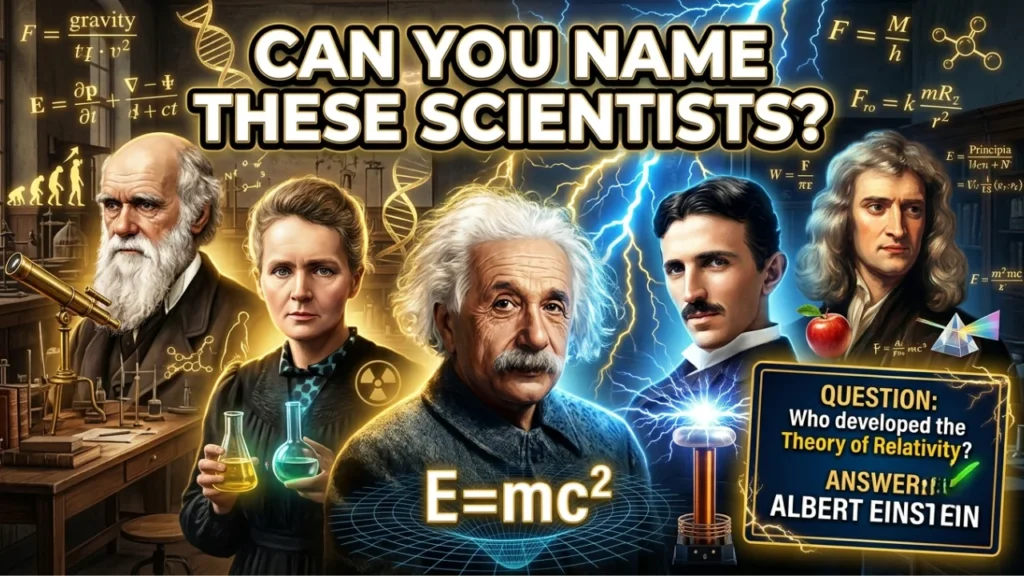
This round blends three subjects into one science trivia questions and answers deep dive: the human body, the elements, and the planet beneath your feet.
Biology
- What is the basic unit of life? The cell
- What molecule carries genetic instructions in living things? DNA
- What is the process of cell division called? Mitosis
- What organ produces insulin? The pancreas
- What is the smallest bone in the human body? The stapes, located in the ear
- What is the longest bone in the human body? The femur, or thigh bone
- What type of blood cells fight infection? White blood cells
- What blood type is the universal donor? O negative
- What pigment gives plants their green color? Chlorophyll
- What is the term for organisms that make their own food? Autotrophs
- How many pairs of chromosomes do humans have? 23 pairs
- What organ produces bile? The liver
- What is the term for a group of similar cells working together? Tissue
- What is the fluid part of blood called? Plasma
- What is the study of heredity called? Genetics
Chemistry
- What is the chemical symbol for gold? Au
- How many elements are on the periodic table? 118
- What is the pH of pure water? 7, which is neutral
- What is the most abundant gas in Earth’s atmosphere? Nitrogen, at about 78%
- Who is considered the father of the modern periodic table? Dmitri Mendeleev, who arranged it in 1869
- What is the chemical formula for table salt? NaCl
- What gas is released when an acid reacts with a carbonate? Carbon dioxide
- What is the term for elements in the far-right column of the periodic table? Noble gases
- What is an exothermic reaction? A chemical reaction that releases heat into its surroundings
- What is the atomic number of carbon? 6
- What element is found in every organic compound? Carbon
- What is the process of iron reacting with oxygen called? Oxidation, better known as rusting
- What type of bond forms when atoms share electrons? A covalent bond
- What is the chemical name for laughing gas? Nitrous oxide, or N₂O
- What acid is found in vinegar? Acetic acid
Earth Science
- What percentage of Earth’s surface is covered by water? About 71%, according to the <a href=”https://www.usgs.gov/special-topics/water-science-school” target=”_blank” rel=”noopener”>U.S. Geological Survey</a>
- What is the largest desert in the world? Antarctica, since a desert is defined by low precipitation, not heat
- What are the three main layers of the Earth? The crust, mantle, and core
- What scale measures earthquake magnitude? The Richter scale
- What is the name of Earth’s ancient supercontinent? Pangea
- What is the term for large slabs of Earth’s crust that drift over the mantle? Tectonic plates
- What are the three main rock types? Igneous, sedimentary, and metamorphic
- What is the tallest mountain on Earth? Mount Everest, at 29,032 feet
- What layer of the atmosphere protects Earth from UV radiation? The ozone layer, found in the stratosphere
- What is the process by which rock breaks down over time called? Weathering
- What is magma called once it reaches Earth’s surface? Lava
- What is a volcano called when it’s not currently erupting? Dormant
- What is the term for the boundary where tectonic plates meet in the Pacific Ocean? The Ring of Fire
- What natural material formed most of today’s coal and oil? Ancient plant and marine matter, compressed over millions of years
- How much of Earth’s freshwater is locked in glaciers and ice caps? About 68%
Famous Scientists Trivia Questions and Answers
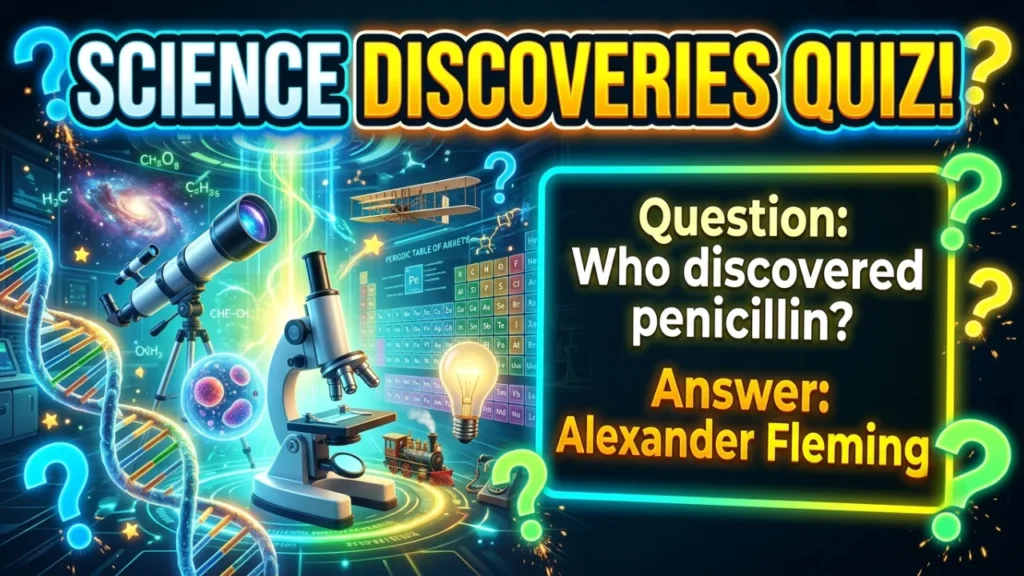
Every discovery has a name behind it. This section of science trivia questions with answers covers the people who shaped modern science.
- Who proposed the theory of evolution by natural selection? Charles Darwin, in his 1859 book On the Origin of Species
- Who formulated the three laws of motion? Sir Isaac Newton
- Who developed the theory of general relativity? Albert Einstein
- What equation is Einstein most famous for? E = mc², showing that mass and energy are interchangeable
- Who discovered penicillin? Alexander Fleming, in 1928, after noticing mold killing bacteria in a petri dish
- Who was the first woman to win a Nobel Prize? Marie Curie
- What two sciences did Marie Curie win Nobel Prizes in? Physics and chemistry
- What elements did Marie Curie discover? Polonium and radium
- Who is known for championing alternating current (AC) electricity? Nikola Tesla
- Who confirmed the heliocentric model using a telescope? Galileo Galilei, in the early 1600s
- Who wrote A Brief History of Time? Stephen Hawking
- Who described the double-helix structure of DNA in 1953? James Watson and Francis Crick
- Who provided key X-ray evidence used to discover DNA’s structure? Rosalind Franklin, through her work known as Photo 51
- Who discovered oxygen in 1774? Joseph Priestley
- Who is considered the father of modern chemistry? Antoine-Laurent Lavoisier
- Who developed the first successful polio vaccine by injection? Jonas Salk
- Who developed the oral polio vaccine? Albert Sabin
- Who proved that lightning is a form of electricity? Benjamin Franklin, through his famous kite experiment
- Who first proposed the heliocentric model of the solar system? Nicolaus Copernicus
- Who is credited with discovering the law of universal gravitation? Isaac Newton, reportedly inspired by a falling apple
- Who developed the smallpox vaccine, the first vaccine ever created? Edward Jenner
- Who is known as the father of genetics? Gregor Mendel, for his work with pea plants
- Who discovered the electron? J.J. Thomson, in 1897
- Who developed the periodic table used today? Dmitri Mendeleev
- Who was the first American woman in space? Sally Ride
- Who was the first person in space? Yuri Gagarin, a Soviet cosmonaut, in 1961
- Who discovered radioactivity? Henri Becquerel
- Who invented the telephone? Alexander Graham Bell
- Who developed the theory of plate tectonics? Alfred Wegener first proposed continental drift in 1912, which later evolved into plate tectonic theory
- Who discovered the structure of the atom’s nucleus? Ernest Rutherford
- Who is known for his work on natural selection alongside Darwin? Alfred Russel Wallace
- Who invented the first practical steam engine used widely in industry? James Watt
- Who discovered X-rays? Wilhelm Röntgen, in 1895
- Who developed the germ theory of disease? Louis Pasteur
- Who is credited with inventing the World Wide Web? Tim Berners-Lee, in 1989
FAQs
What are the top science quiz questions?
Some of the most popular science quiz questions include: What is the largest planet in our solar system? (Jupiter), What is the chemical symbol for water? (H₂O), What is the fastest land animal? (The cheetah).
What are interesting facts about science?
A few standouts: Antarctica is technically the world’s largest desert. Sunsets on Mars appear blue, not red. Sharks existed before trees. The human body has enough bones to build a small skeleton twice over (206 in adults). Light from the Sun takes about 8 minutes to reach Earth.
What are 5 hard trivia questions?
Try these: What is the rarest naturally occurring element on Earth? (Astatine). What is the half-life of carbon-14? (About 5,730 years). What planet rotates on its side? (Uranus). What is the Chandrasekhar limit?
What is the hardest question in science?
Many scientists point to the nature of consciousness, sometimes called “the hard problem,” as one of the toughest open questions. Others cite unifying gravity with quantum mechanics, understanding dark matter and dark energy, or explaining what happened before the Big Bang.
Conclusion
Science rewards curiosity more than memorization. Whether you nailed the easy round or got stuck on quantum entanglement, every question here is a small doorway into a bigger idea. Bookmark this list, quiz your friends, and see who can walk away with bragging rights.

William Vicky is the lead writer and trivia curator at Trivia Questioners, with a passion for uncovering fascinating facts across history, science, pop culture, and general knowledge. He loves crafting questions that challenge and delight readers of all ages.