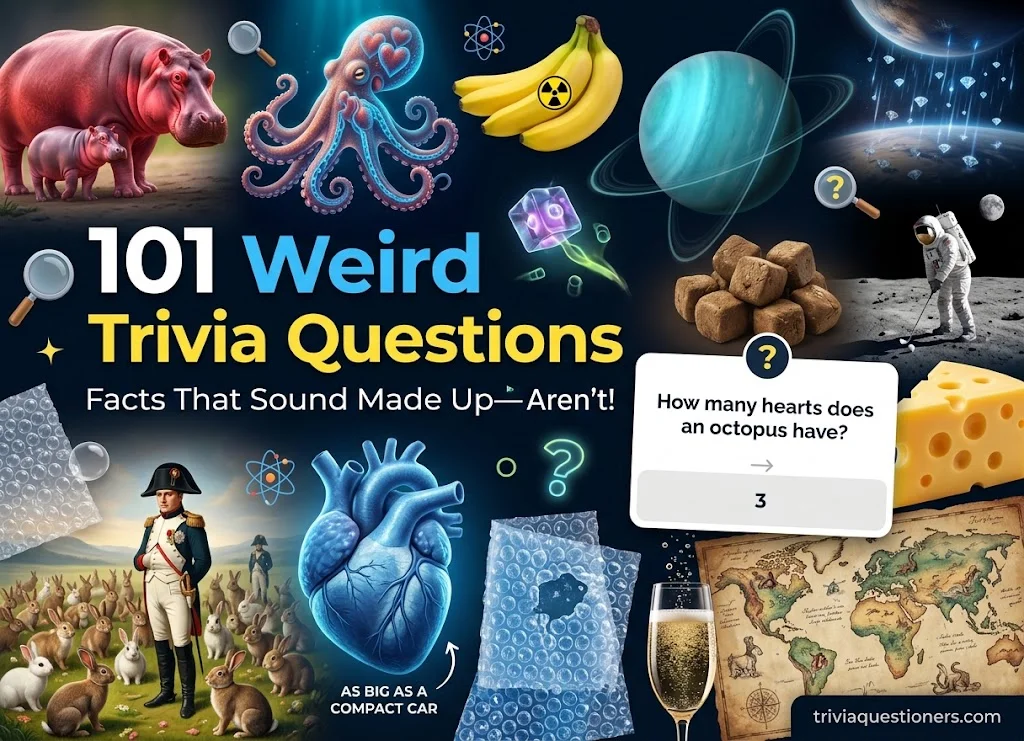
Some facts sound too strange to be real. A cloud made of alcohol floating in outer space? Cheese being the most stolen food on the planet? They sound like jokes, but every one of these weird trivia questions below has a fact-checked, true answer behind it.
Below are 101 numbered weird trivia questions and answers, split into five categories. Use them for a quiz night, a classroom warm-up, or just to send your group chat into chaos.
Table of Contents
Weird Science and Nature Trivia Questions
Nature and physics break their own rules more often than you’d think. These weird trivia questions cover space, chemistry, and biology facts that sound invented.
- Which planet in our solar system is the hottest, even though it isn’t closest to the sun?
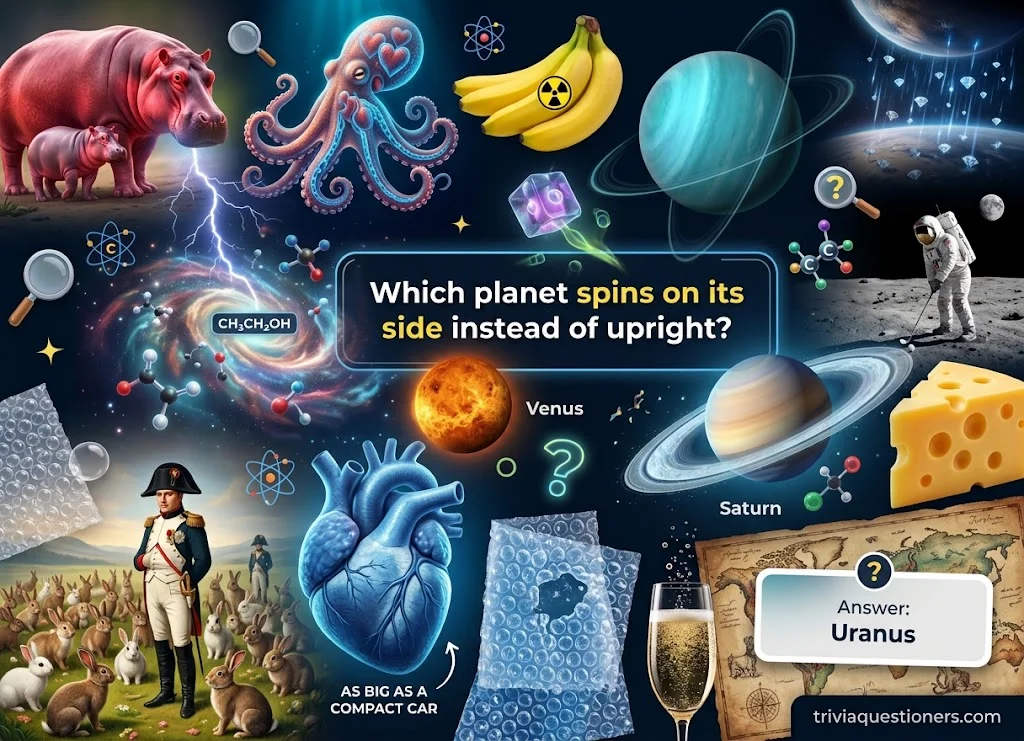
Venus. Its thick atmosphere traps heat so well that surface temperatures reach around 864°F — hotter than Mercury, which actually sits closer to the sun. - Which planet spins on its side instead of upright?
Uranus. Its axis is tilted about 98 degrees, so it essentially rolls around the sun like a ball instead of spinning like a top. - What color is hippo sweat?
Reddish-pink. It isn’t blood or true sweat — it’s a natural fluid that acts like sunscreen and helps fight off infection. - Can honey ever go bad?
No. Archaeologists have found pots of honey in ancient Egyptian tombs that were still edible thousands of years later, thanks to its low moisture and natural acidity. - How many possible combinations does a standard Rubik’s Cube have?
Over 43 quintillion — that’s 43,252,003,274,489,856,000 combinations from a single toy. - What is the hardest substance in the human body?
Tooth enamel. It’s harder than bone, which is why teeth can survive decades of chewing. - Are bananas radioactive?
Yes, slightly. Bananas contain potassium-40, a naturally radioactive isotope, though the amount is far too small to cause any harm. - What’s hotter: a bolt of lightning or the surface of the sun?
Lightning. A single bolt can reach around 30,000 Kelvin, roughly five times hotter than the sun’s surface. - Is glass technically a liquid?
No — that’s a common myth. Glass is an amorphous solid. Old windows look thicker at the bottom because of how they were manufactured, not because the glass slowly “flowed” over time. - What are Saturn’s rings mostly made of?
Ice. Saturn’s rings are made up mostly of ice particles, with a smaller amount of rocky debris and dust mixed in. - What shape is wombat poop?
Cube-shaped. Wombats are the only animal known to produce cube-shaped droppings, which helps keep them from rolling away as territory markers. - Which came first on Earth: sharks or trees?
Sharks. Sharks have existed for roughly 400 million years, while the first trees appeared around 350 million years ago. - Is a day on Earth always exactly 24 hours?
Not quite. Earth’s rotation is very gradually slowing down due to the moon’s gravitational pull, so days lengthen by about 1.8 milliseconds per century. - On which planets does it actually “rain” diamonds?
Neptune and Uranus. Scientists believe extreme pressure in their atmospheres compresses carbon into diamond rain. - Is there really a giant cloud of alcohol floating in space?
Yes. A gas cloud called Sagittarius B2, near the center of the Milky Way, contains ethyl alcohol and is trillions of miles wide. - Is a strawberry actually a berry?
No — botanically, strawberries aren’t true berries. Oddly, bananas, tomatoes, and avocados technically qualify as berries under the botanical definition. - How fast does a human sneeze travel?
Around 100 miles per hour, fast enough to launch mucus droplets several feet. - How much does an average cloud weigh?
About 1.1 million pounds. Clouds look weightless because their water droplets are spread across a huge volume of air. - Are there more possible unique chess games than atoms in the observable universe?
Yes. The number of possible chess games is estimated to exceed the total number of atoms in the observable universe. - Can water freeze faster when it starts out hot?
Sometimes, yes. This is called the Mpemba effect, and while scientists still debate the exact cause, hot water has been observed freezing faster than cold water under certain conditions.
Must Visit: 105+ SpongeBob Trivia Questions With Answers (Easy to Hard)
Weird Animal Trivia Questions You Won’t Believe Are True
Animals hold some of the best weird trivia questions out there. These facts about hearts, brains, and habits sound invented, but they check out.
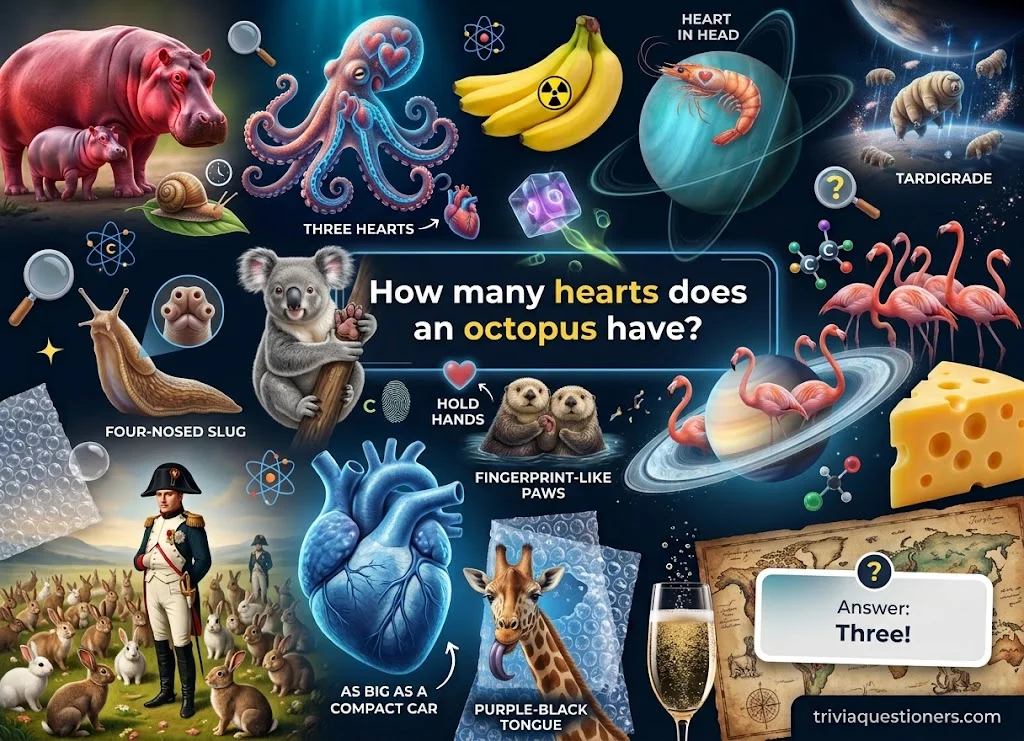
- How many hearts does an octopus have?
Three. Two pump blood to the gills, and one pumps it to the rest of the body. - Which animal’s fingerprints are almost identical to a human’s?
The koala. Their fingerprints are so close to human ones that they’ve occasionally confused forensic investigators at crime scenes. - Which large land mammal can’t jump at all?
The elephant. Their leg structure and body weight make jumping physically impossible for them. - What is the top speed of a cheetah?
Around 70 miles per hour in short bursts, making it the fastest land animal on Earth. - What is a group of flamingos called?
A flamboyance. - How many noses does a slug have?
Four. - How long can a snail sleep without waking up?
Up to three years, especially during dry or cold conditions. - Does a starfish have a brain?
No. Starfish have no brain at all — their nervous system is spread throughout their arms. - Where is a shrimp’s heart located?
In its head. - What do you call a group of pandas?
An embarrassment. - Do dolphins actually have names for each other?
Yes. Dolphins develop unique “signature whistles” that function similarly to names, and other dolphins use them to call to specific individuals. - Why do sea otters hold hands while sleeping?
So they don’t drift apart in the water while resting, sometimes forming a floating group called a “raft.” - Can tardigrades survive in outer space?
Yes. These microscopic animals can survive the vacuum of space, extreme radiation, and near-freezing temperatures. - What color is a giraffe’s tongue?
Purplish-black, which scientists believe helps protect it from sunburn since giraffes spend hours a day with their tongues exposed while feeding. - Which animal can’t stick out its tongue?
The crocodile. Its tongue is anchored to the roof of its mouth by a membrane. - What do you call a group of crows?
A murder. - Are dog nose prints unique, like human fingerprints?
Yes. Every dog’s nose print pattern is unique, and some organizations use them to identify individual dogs. - How strong is a mantis shrimp’s punch?
Strong enough to shatter aquarium glass. Its strike accelerates faster than a bullet leaving a gun. - How long can it take a sloth to digest one meal?
Up to 30 days. - How big is a blue whale’s heart?
Roughly the size of a small car, and it’s the largest heart of any living animal. - What do butterflies use to taste their food?
Their feet. Butterflies have taste receptors on their feet that let them sample a plant before deciding whether to feed or lay eggs on it.
Weird History and Human Body Trivia Questions
History and biology are full of facts that sound like exaggerations. These weird trivia questions prove otherwise.
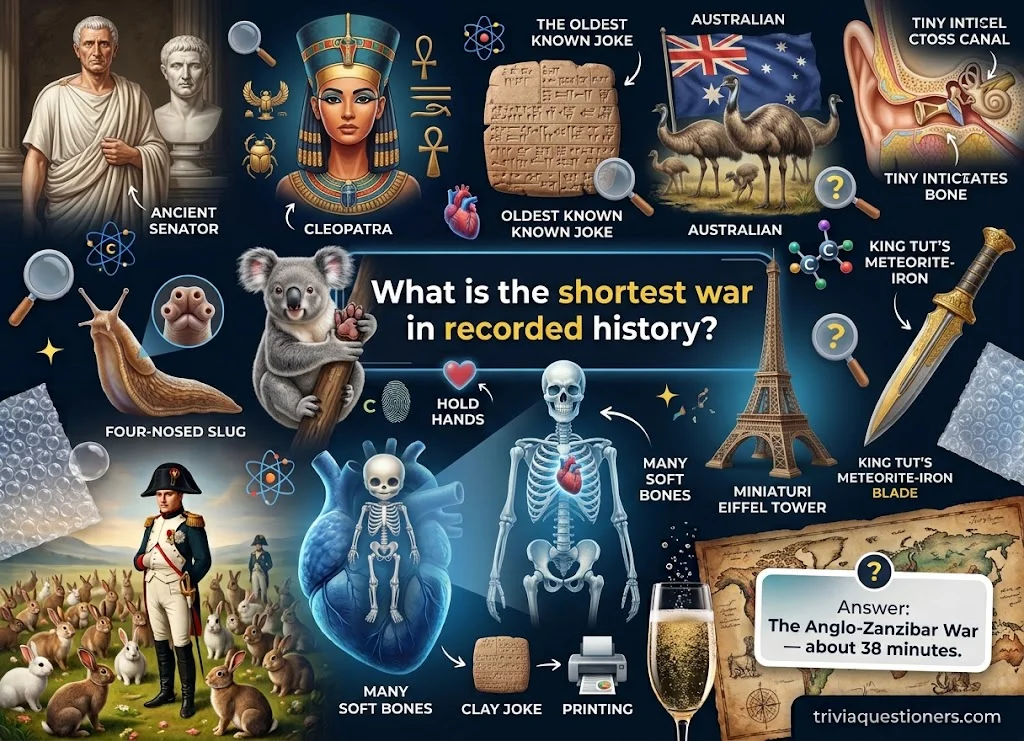
- What is the shortest war in recorded history?
The Anglo-Zanzibar War of 1896, which lasted only about 38 minutes. - What did ancient Romans use as mouthwash?
Urine. It was believed to have whitening and cleansing properties, and imported Portuguese urine was even considered a premium product. - How did Cleopatra reportedly prove her wealth at a dinner party?
She dissolved a priceless pearl in vinegar and drank it, according to Roman historical accounts. - What happened to Napoleon during a rabbit hunt?
He was reportedly swarmed and chased off by a horde of aggressive rabbits instead of them running away. - What was the outcome of Australia’s “Great Emu War” in 1932?
Soldiers were sent with machine guns to control emu populations destroying crops — and the emus largely won, leading the military to withdraw. - How many bones do babies have compared to adults?
Babies are born with around 300 bones, but many fuse together as they grow, leaving adults with 206. - Where is the smallest bone in the human body located?
In the ear. The stapes bone, involved in hearing, is the tiniest bone in the human skeleton. - Was Cleopatra closer in time to the Moon landing or to the building of the Great Pyramid?
The Moon landing. The pyramids were built about 2,500 years before Cleopatra’s reign, while she lived roughly 2,000 years before Apollo 11. - Which is older: Oxford University or the Aztec Empire?
Oxford University. Teaching there is documented as early as 1096, while the Aztec Empire wasn’t founded until 1428. - Roughly how much DNA do humans share with bananas?
About half, according to genetic researchers — a reminder of how much basic biology is shared across very different life forms. - Do fingernails or toenails grow faster?
Fingernails, by roughly three to four times. - How much blood does the human heart pump in a day?
Around 2,000 gallons, even at rest. - Is stomach acid strong enough to dissolve metal?
Yes. Human stomach acid has a pH low enough to dissolve certain metals over time, which is part of why the stomach lining constantly regenerates. - Are humans the only animals known to blush?
Yes, according to Charles Darwin’s own research — blushing appears to be a uniquely human physical response. - Can the human brain generate electricity?
Yes. The brain generates enough electrical activity to be measured in watts, though not enough to power a lightbulb on its own — a popular myth exaggerates this. - What unusual material was King Tut’s dagger made from?
Meteorite iron, confirmed by scientific analysis of its composition. - Was the Eiffel Tower almost torn down?
Yes. It was originally built as a temporary structure for the 1889 World’s Fair and was nearly demolished afterward, but it was kept because it proved useful for radio transmissions. - About how many skin cells does a person shed per hour?
Around 30,000 to 40,000, adding up to several pounds of skin shed per year. - How many words does the average person speak in a single day?
Around 16,000, according to linguistic research. - How old is the oldest known joke on record?
About 4,000 years old — a Sumerian proverb involving flatulence, discovered on an ancient clay tablet.
Weird Food, Space, and Everyday Object Trivia Questions
Everyday items and inventions have surprisingly strange backstories. These weird trivia questions cover food, gadgets, and space oddities.
- What is the most stolen food in the world?
Cheese. It’s reportedly targeted by an estimated 4% of all food theft worldwide, according to global crime research. - What was ketchup originally sold as in the 1830s?
Medicine. It was marketed as a cure for digestive issues like diarrhea. - What was the first product ever scanned with a barcode?
A pack of Wrigley’s chewing gum, scanned at an Ohio supermarket in 1974. - What sport did astronaut Alan Shepard play on the Moon?
Golf. During the Apollo 14 mission in 1971, he hit two golf balls using a modified club. - How does a day on Venus compare to a year on Venus?
A day on Venus (243 Earth days) is actually longer than its year (225 Earth days), because it rotates so slowly. - Is the Eiffel Tower actually taller in summer?
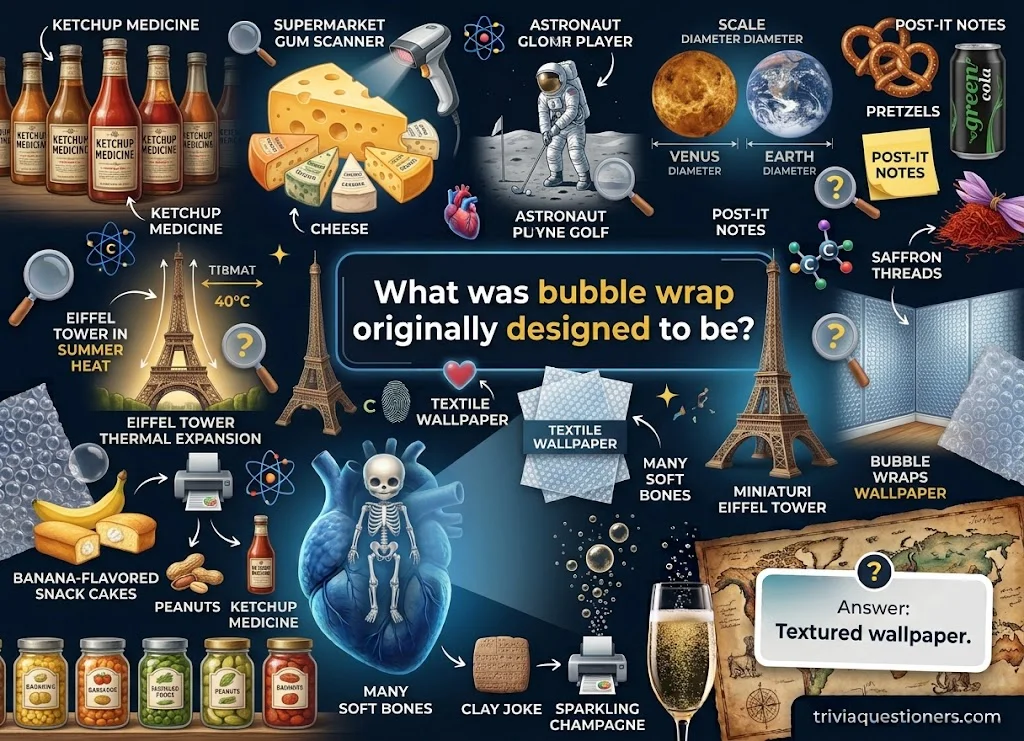
Yes. Heat causes the iron to expand, making the tower grow by up to 6 inches during hot weather. - What was bubble wrap originally designed to be?
Textured wallpaper. It wasn’t a hit as decor, but it found huge success as packaging material instead. - What flavor were Twinkies originally?
Banana. The flavor switched to vanilla during World War II due to a banana shortage and never changed back. - Why were pretzels originally created?
Monks in medieval Europe are believed to have made them as rewards for children who memorized their prayers, with the twisted shape representing arms crossed in prayer. - What color was Coca-Cola originally?
Green, before it became the caramel-brown color it is now. - What was Listerine originally marketed as?
A floor cleaner and surgical antiseptic before it was rebranded as a mouthwash decades later. - How were Post-it Notes invented?
By accident. A scientist at 3M was trying to create a super-strong adhesive but ended up with a weak, reusable one that became the sticky note. - Are peanuts actually nuts?
No. Peanuts are legumes, more closely related to beans and lentils than to tree nuts like almonds or walnuts. - Were tomatoes once believed to be poisonous?
Yes. Many people in Europe and early America avoided eating tomatoes until the 1800s, partly because the acid in tomatoes reacted with pewter plates and released lead. - What does the “M” in M&M’s stand for?
Mars and Murrie, the last names of the candy’s founders. - What is the world’s most expensive spice by weight?
Saffron, which can cost more per ounce than some precious metals due to how labor-intensive it is to harvest. - How many possible chess openings exist compared to how many are commonly played?
Millions are mathematically possible, but professional players typically rely on only a small, well-studied set of them. - What did ancient Egyptians reportedly use to help pay pyramid workers?
Onions, along with bread, beer, and garlic — evidence suggests workers were paid, not enslaved, as once assumed. - What is champagne’s approximate bubble count per glass?
Around 49 million bubbles, according to studies on carbonation in sparkling wine. - Which everyday food item never technically spoils if stored properly?
Honey, as mentioned earlier — one of the only foods with an essentially infinite shelf life.
Weird Pop Culture and Geography Trivia Questions
Even modern culture and world geography have facts strange enough to sound fictional. Round out your weird trivia questions list with these.
- What was the first message ever sent over the internet?
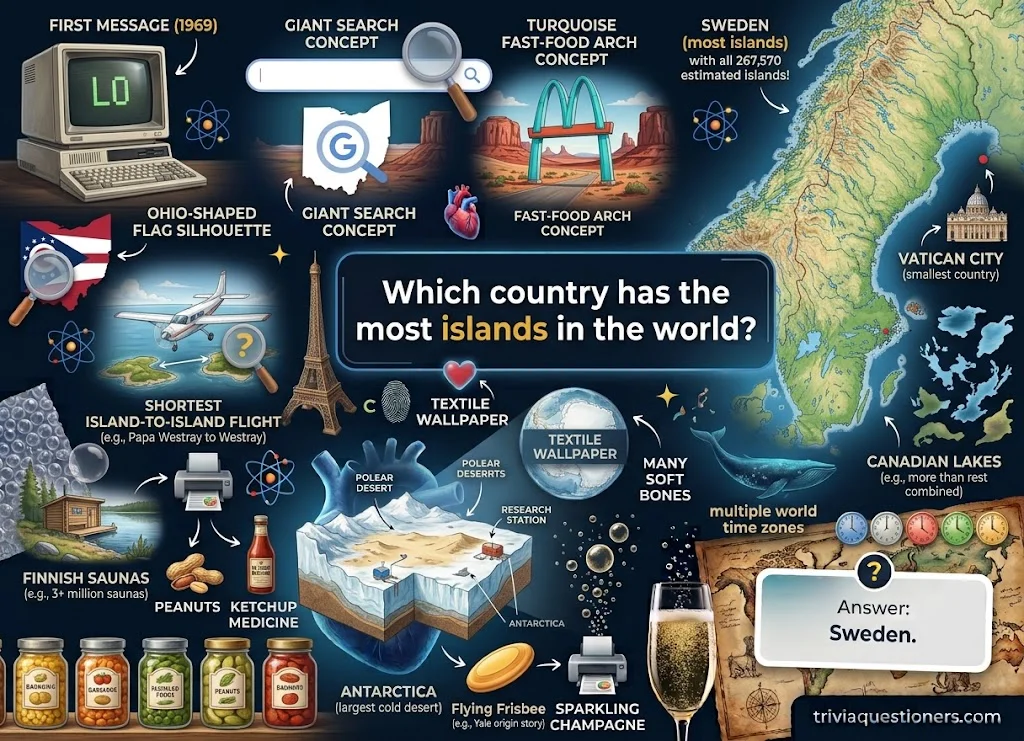
“LO.” Researchers were trying to type “LOGIN,” but the system crashed after the second letter. - Which country has the most islands in the world?
Sweden, with an estimated 267,570 islands. - What is the smallest country in the world?
Vatican City, at just over 100 acres, entirely surrounded by Rome, Italy. - How short is the world’s shortest commercial flight?
Under two minutes. The flight between two islands in Scotland’s Orkney Islands can take as little as 47 seconds in ideal conditions. - Which country has more saunas than cars?
Finland, which is estimated to have around 3 million saunas for a population of about 5.5 million people. - What happened to the inventor of the Frisbee after he died?
Per his wishes, his ashes were molded into memorial Frisbee discs and given to family and friends. - Where does the name “Google” come from?
It’s a play on “googol,” a mathematical term for the number 1 followed by 100 zeros, meant to reflect the company’s goal of organizing a huge amount of information. - Which country has more lakes than the rest of the world combined?
Canada, home to an estimated 2 million lakes. - Which U.S. state has a flag that isn’t rectangular?
Ohio. Its flag is a burgee (swallow-tail) shape instead of the standard rectangle. - What is the most common street name in the United States?
Second Street, more common than “Main Street,” according to U.S. Census research. - Which continent is technically classified as a desert?
Antarctica. Despite being covered in ice, it receives very little precipitation, qualifying it as the largest desert on Earth. - What is unusual about the “loneliest whale” in the ocean?
A whale nicknamed the “52 Hertz Whale” sings at a frequency no other known whale species uses, meaning other whales likely can’t hear or respond to it. - Which country has the most time zones, including its territories?
France, with 12 time zones when overseas territories are counted. - Where do most Canadians live in relation to the U.S. border?
About 90% of Canada’s population lives within 100 miles of the U.S. border. - Why are the McDonald’s arches in Sedona, Arizona, turquoise instead of gold?
Local zoning laws required the color to blend in better with the region’s natural red-rock landscape. - What does the “M” in the phrase “the Big Mac” actually reference? (Bonus food/pop-culture crossover)
Nothing hidden — “Mac” simply comes from “Big Mac,” named by the employee who created the sandwich in the 1960s, without any deeper acronym behind it. - How many countries border only one other country?
Several, but famously the U.S. state of Maine borders only one other U.S. state — New Hampshire — despite the country’s larger size. - What is the only sport ever played on the Moon?
Golf, thanks to Alan Shepard’s Apollo 14 swing, referenced earlier in this list. - Which fictional wizard’s real first name is often mistaken as a mystery?
Gandalf, from The Lord of the Rings — despite fan confusion, “Gandalf” is his actual name; it isn’t a nickname or title. - What is the most-watched YouTube video of all time?
“Baby Shark Dance,” which has amassed billions of views since its release, making it one of the most-watched pieces of media in human history.
FAQs
What are weird trivia questions?
Weird trivia questions are fact-based questions built around information that sounds unbelievable or made up, even though it’s completely true. They usually cover science, history, animals, or pop culture facts that surprise most people.
What are some good weird trivia questions to ask friends?
Questions with a strong “wait, really?” factor work best, like how many hearts an octopus has, what color hippo sweat is, or which planet spins on its side. Mixing categories keeps the game unpredictable.
Where can I find weird trivia questions with answers?
This list is a solid starting point, with 101 fact-checked questions across science, animals, history, food, and geography. Trivia apps, quiz-night platforms, and reference sites also publish similar collections.
Are weird trivia questions suitable for kids and adults?
Most weird trivia questions work well for both, since they’re based on genuine facts rather than mature content. It’s still smart to preview questions ahead of time if you’re playing with younger kids, especially ones involving historical topics.
How can I use weird trivia questions for a fun quiz game?
Split the group into teams, read one question at a time, and give points for correct answers. For extra energy, try a “true or false” format first, then reveal the full explanation behind each answer.
Conclusion
Reality is often stranger than fiction, from radioactive bananas to a rabbit ambush that scared off Napoleon. These 101 weird trivia questions prove that the truth doesn’t need embellishing to be entertaining. Save this list for your next game night, and don’t be surprised if a few answers get argued about.

William Vicky is the lead writer and trivia curator at Trivia Questioners, with a passion for uncovering fascinating facts across history, science, pop culture, and general knowledge. He loves crafting questions that challenge and delight readers of all ages.