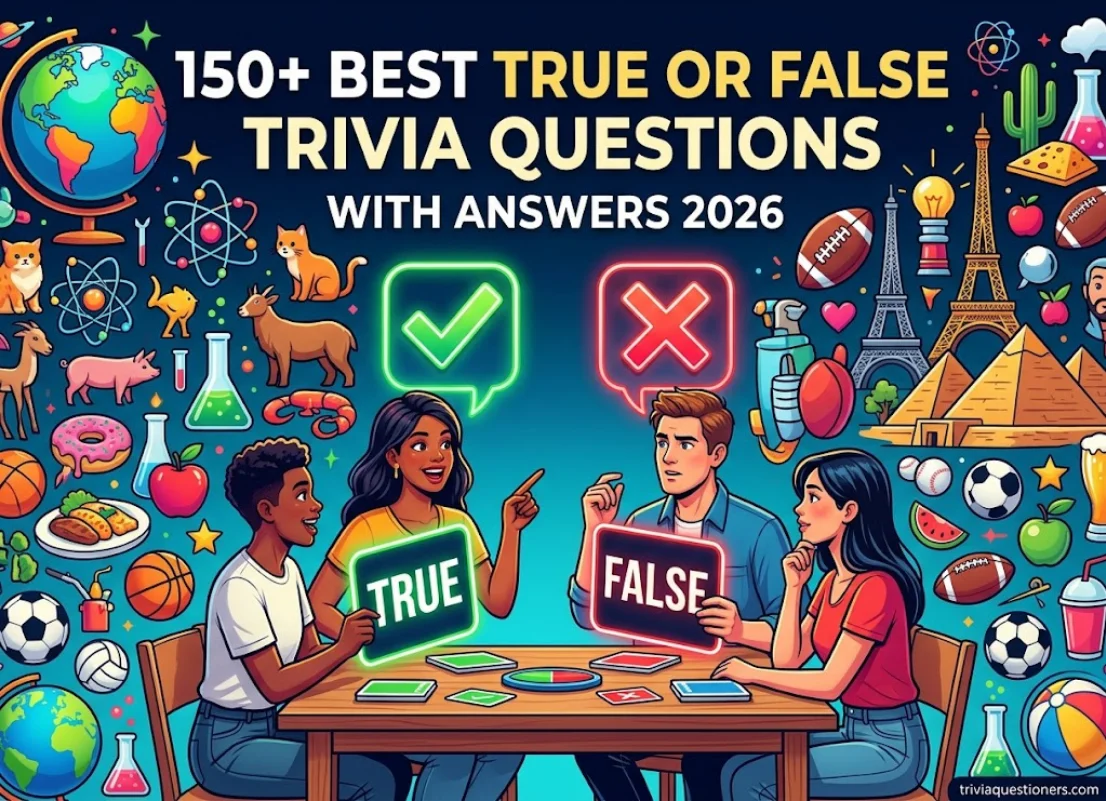
True or false trivia questions are one of the fastest ways to test what people actually know versus what they only think they know. With just two possible answers, every question turns into a mini gut-check, and the best ones flip a belief you never thought to question.
Below you’ll find 150+ true or false trivia questions with answers, sorted into easy categories you can jump into right away. Whether you’re hosting trivia night, running a classroom warm-up, or just want sharp general knowledge questions for a game night, this list has you covered from beginner facts to genuine stumpers.
Table of Contents
Easy & General Knowledge True or False Trivia Questions
These true or false questions are a great warm-up round, most people will get a majority right, but a few classic myths are hiding in the mix.
- The sun rises in the east. True. Earth spins west to east, so sunrise always happens in the east.
- The English alphabet has 26 letters. True. A through Z.
- Spiders are insects. False. Spiders are arachnids, with eight legs instead of an insect’s six.
- A square has four equal sides. True. That’s the basic definition of a square.
- Water freezes at 0°C (32°F). True. At standard atmospheric pressure.
- A year has 12 months. True. Based on the modern Gregorian calendar.
- Humans have exactly five senses. False. Balance, temperature, and pain are also senses, pushing the real count well past five.
- The Great Wall of China is visible from space with the naked eye. False. Astronauts have confirmed it’s too narrow to see unaided, even from low orbit.
- Bats are blind. False. All bat species can see; many also use echolocation to navigate in the dark.
- There are seven continents on Earth. True. Africa, Antarctica, Asia, Australia, Europe, North America, and South America.
- An octopus has three hearts. True. Two pump blood to the gills, and one pumps it to the rest of the body.
- Honey never spoils. True. Sealed honey found in ancient tombs has still been edible thousands of years later.
- Lightning never strikes the same place twice. False. Tall structures get struck repeatedly — the Empire State Building is hit dozens of times a year.
- Sound travels faster than light. False. Light moves nearly a million times faster, which is why thunder always trails lightning.
- The average adult human body has 206 bones. True. Babies are born with closer to 300, which fuse together over time.
- Wild penguins live at the North Pole. False. Penguins live in the Southern Hemisphere; polar bears are the northern ones.
- Mount Everest is the tallest mountain above sea level. True. It stands roughly 8,849 meters tall.
- A century equals 100 years. True. From the Latin word centum.
- Dogs cool themselves down mainly by sweating through their skin. False. Dogs cool off by panting, with a little help from sweat glands in their paw pads.
- The Pacific is the largest ocean on Earth. True. It’s bigger than all of the planet’s landmass combined.
- Bananas grow on trees. False. The banana plant is technically a giant herb, not a tree.
- Goldfish only have a three-second memory. False. Studies show goldfish can retain memories for months.
- Humans only use 10% of their brains. False. Brain scans confirm nearly all regions are active throughout the day.
- A leap year happens every four years without exception. False. Century years must be divisible by 400 — 1900 wasn’t a leap year, but 2000 was.
- A tomato is botanically a fruit. True. It develops from a flower and contains seeds, which technically makes it a fruit.
- Hair and fingernails keep growing after death. False. Skin simply retracts as it dries out, creating the illusion of growth.
- Cracking your knuckles causes arthritis. False. It just releases gas bubbles from the joint fluid — it doesn’t damage the joint.
- Chameleons change color mainly to blend into their surroundings. False. They mostly shift color to regulate temperature and signal mood.
- All 50 U.S. states have an ocean coastline. False. Several states, like Kansas and Nebraska, are entirely landlocked.
- A week has seven days. True. A convention that dates back thousands of years.
Must Visit: 101 Weird Trivia Questions That Sound Made Up (But Aren’t!)
Science & Nature True or False Trivia Questions
Science is one of the richest categories for true or false trivia questions, since so many “facts” people repeat turn out to be folk myths.
- Pure water conducts electricity well. False. Pure water is actually a poor conductor — it’s the dissolved minerals and ions that carry the current.
- Glass is technically a slow-flowing liquid at room temperature. False. Glass is an amorphous solid; older windowpanes are just uneven due to how they were manufactured.
- DNA stands for deoxyribonucleic acid. True. It’s the molecule that carries genetic instructions in nearly all living things.
- Humans share roughly 60% of their DNA with bananas. True. Basic cellular machinery is shared across nearly all life on Earth.
- Antibiotics can kill viruses. False. Antibiotics only work against bacteria, which is why they don’t treat colds or the flu.
- The speed of light is about 300,000 kilometers per second. True. Precisely, it’s 299,792 km/s in a vacuum.
- Sound cannot travel through the vacuum of space. True. With no medium to carry the waves, space stays silent.
- Diamonds are the hardest naturally occurring material on Earth. True. They top the Mohs hardness scale at 10.
- Mercury is the only metal that stays liquid at room temperature. True. Gallium comes close but needs a slightly warmer temperature to melt.
- Venus is the hottest planet in the solar system. True. Its thick, greenhouse-trapping atmosphere makes it hotter than Mercury, even though Mercury is closer to the sun.
- Electrons are larger than atoms. False. Electrons are subatomic particles, thousands of times smaller than even the tiniest atom.
- The human brain uses about 20% of the body’s total energy. True. Remarkable, considering the brain is only about 2% of body weight.
- Human blood is blue inside the body until it’s exposed to oxygen. False. Blood is always red; veins only appear bluish because of how skin filters light.
- A vacuum contains no air. True. By definition, a true vacuum is a space empty of matter, including air.
- Helium was discovered in the sun before it was ever found on Earth. True. It was spotted in the sun’s light spectrum in 1868, decades before its discovery here.
- Absolute zero is −273.15°C. True. It’s the theoretical point where atomic motion stops entirely.
- Iron is the most abundant metal in Earth’s crust. False. Aluminum actually holds that title, with iron coming in second.
- Saturn’s rings are extremely thin compared to how wide they are. True. They stretch over 100,000 kilometers across but are only about 100 meters thick in most places.
- Water is classified as a chemical element. False. Water is a compound made of hydrogen and oxygen, not an element on its own.
- A single lightning bolt is hotter than the surface of the sun. True. Lightning can reach around 30,000 Kelvin, versus the sun’s surface at roughly 5,800 Kelvin.
- A stretched rubber band stores potential energy. True. That energy converts to kinetic energy the moment it’s released.
- Earth behaves like a giant magnet. True. Molten iron and nickel flowing in the planet’s core generate its magnetic field.
- Light can bend as it passes near a massive object like a star. True. Einstein predicted this effect, and it was confirmed by observing starlight during a solar eclipse.
- There are more possible chess games than atoms in the observable universe. True. The estimated number of chess game variations vastly outnumbers the atom count.
- The stomach’s lining renews itself every few days. True. Constant renewal protects it from its own digestive acid.
- Sharks existed on Earth before trees did. True. Sharks date back roughly 450 million years; trees came about 100 million years later.
- Silver is the most electrically conductive of all metals. True. It edges out copper and gold in raw conductivity.
- Human skin cells only divide once during a lifetime. False. Skin cells divide dozens of times over a person’s life to keep replacing themselves.
- Oxygen is the most abundant element in the universe. False. Hydrogen holds that title by a wide margin; oxygen is only most abundant in Earth’s crust.
- Mars has two moons. True. They’re named Phobos and Deimos.
History & Geography True or False Trivia Questions
Between famous dates and world maps, this section covers some of the most argued-about true or false trivia questions at any trivia table.
- The Great Fire of London happened in 1666. True. It destroyed most of the medieval city within the old walls.
- Napoleon Bonaparte was famously short for his time. False. At around 5’6″, he was roughly average height for a 19th-century Frenchman.
- The Titanic sank on its maiden voyage. True. It went down in April 1912, just four days into its first crossing.
- Vikings wore horned helmets into battle. False. No archaeological evidence supports this — the image comes from 19th-century opera costumes.
- The Berlin Wall fell in 1989. True. It came down on November 9, following a chaotic press-conference announcement.
- The Hundred Years’ War lasted exactly 100 years. False. It actually ran 116 years, from 1337 to 1453.
- Cleopatra lived closer in time to the Moon landing than to the building of the Great Pyramid. True. The pyramid predates her by about 2,500 years, while she predates Apollo 11 by roughly 2,000.
- Christopher Columbus set sail to prove the Earth was round. False. Educated Europeans already accepted a round Earth; the actual dispute was over its size.
- The guillotine was last used for an execution in France in the 1930s. False. France’s final guillotine execution took place in 1977.
- World War I began in 1914. True. It was triggered that June by the assassination of Archduke Franz Ferdinand.
- Oxford University is older than the Aztec Empire. True. Teaching at Oxford predates the year 1100, while the Aztec Empire formed in the 1400s.
- Women in the United States gained the nationwide right to vote in 1920. True. The 19th Amendment was ratified that year, after decades of activism.
- The shortest war in recorded history lasted under an hour. True. The Anglo-Zanzibar War of 1896 is estimated to have lasted around 38 to 45 minutes.
- Marie Curie won Nobel Prizes in two different scientific fields. True. She won in physics in 1903 and chemistry in 1911.
- Australia is both a country and a continent. True. It’s the only nation that holds both classifications.
- The capital of Australia is Sydney. False. The actual capital is Canberra, purpose-built as a compromise between Sydney and Melbourne.
- Africa is a country. False. It’s a continent made up of 54 recognized countries.
- The Nile is generally considered the world’s longest river. True. Though debate continues over how it compares to the Amazon by some measurements.
- Russia spans 11 time zones. True. More than any other country on Earth.
- The Sahara is the largest desert on Earth. False. Antarctica actually holds that title, since deserts are defined by low precipitation, not heat.
- Canada has the longest coastline of any country in the world. True. Its thousands of islands add enormous length to its total shoreline.
- Istanbul sits on two continents. True. The city straddles Europe and Asia along the Bosphorus Strait.
- The Dead Sea is the lowest land point on Earth. True. Its shores sit roughly 430 meters below sea level.
- Greenland is larger than South America. False. It only appears that way on flat map projections — South America is actually about eight times bigger.
- Mount Kilimanjaro is located in Kenya. False. It’s actually located in neighboring Tanzania.
- Vatican City is the smallest country in the world. True. It covers less than half a square kilometer.
- More than half of the world’s population lives in Asia. True. Roughly 60% of all people on Earth live there.
- Monaco is smaller than New York’s Central Park. True. Monaco covers about 2.1 square kilometers, while Central Park spans about 3.4.
- Bolivia has a coastline on the Pacific Ocean. False. Bolivia is entirely landlocked, having lost its coastal access in an 1800s war.
- Alaska is both the westernmost and easternmost U.S. state. True. Its Aleutian Islands stretch across the 180° meridian, technically placing part of the state in the Eastern Hemisphere.
Animal & Food True or False Trivia Questions
Nature and food both tend to produce true or false questions that sound made up but hold up to a fact check.
- Sharks are mammals. False. Sharks are fish, breathing through gills rather than lungs.
- A group of crows is called a murder. True. English collective nouns for animals are often oddly dramatic.
- Koalas are a type of bear. False. They’re marsupials, more closely related to wombats than to any bear species.
- Owls can rotate their heads a full 360 degrees. False. Their actual range tops out around 270 degrees, still impressive but not a full circle.
- Elephants are the only land mammals that can’t jump. True. Their skeletal structure keeps at least one foot on the ground at all times.
- Wombats produce cube-shaped droppings. True. The unusual shape keeps their territorial markers from rolling away.
- Flamingos are naturally pink from birth. False. They’re born gray; pigments from their diet turn them pink over time.
- A shrimp’s heart is located near its head. True. Technically in the thorax, just behind the head.
- Sea otters hold hands while sleeping. True. It keeps them from drifting apart on the water’s surface.
- Some jellyfish are considered biologically immortal. True. The species Turritopsis dohrnii can revert back to a juvenile stage instead of dying.
- Polar bear skin is black underneath their fur. True. The dark skin helps absorb and retain heat.
- Camels store water in their humps. False. Their humps actually store fat; water is managed elsewhere in their bodies.
- A snail can sleep for up to three years. True. During extreme drought conditions, snails can enter a long dormant state.
- Cows form close social bonds and get stressed when separated from them. True. Studies have shown cattle display clear signs of stress when parted from familiar herd mates.
- Dolphins sleep with only half their brain resting at a time. True. This lets them keep swimming and breathing while still getting rest.
- White chocolate contains no cocoa solids. True. It’s made from cocoa butter, sugar, and milk, which fuels ongoing debate over whether it even counts as real chocolate.
- Strawberries are classified as botanical berries. False. They’re actually aggregate accessory fruits; bananas and grapes are true botanical berries.
- Peanuts are a type of nut. False. They’re legumes, growing in pods underground like peas.
- Pineapples grow on trees. False. Each pineapple grows from a low, spiky ground plant.
- Carrots were originally purple, not orange. True. Orange carrots became popular through Dutch growers in the 1600s.
- Coffee “beans” are technically seeds. True. They come from the pit of a cherry-like fruit, not a true bean.
- Ketchup was once sold in the U.S. as medicine. True. In the 1830s, tomato ketchup was marketed in pill form as a cure-all.
- Apples float in water because they’re about 25% air. True. That trapped air is exactly why bobbing for apples works.
- Most wasabi served in American restaurants is actually dyed horseradish. True. Real wasabi is costly and loses its flavor within minutes of being grated.
- Chocolate is toxic to dogs. True. A compound called theobromine, which humans process easily, is dangerous for dogs.
- Rice is the primary food staple for more than half the world’s population. True. It’s especially central to diets across Asia.
- Vanilla comes from a flower, not a tree. True. It’s harvested from a type of orchid.
- Lemons contain more sugar, gram for gram, than strawberries. True. Their strong acidity just masks how sweet they actually are.
- Bananas are naturally radioactive. True. They contain trace amounts of potassium-40, though far too little to pose any health risk.
- A tomato is classified as a vegetable in most cooking and culinary contexts, despite being a fruit botanically. True. This distinction has settled more than one kitchen argument.
Pop Culture, Sports & Tricky True or False Trivia Questions
This final batch blends entertainment, sports, and a few offbeat facts about language and technology, a mix most true or false trivia questions lists skip over.
- The first iPhone was released in 2007. True. It was announced in January and hit stores that June.
- Snow White and the Seven Dwarfs was Disney’s first full-length animated feature film. True. It premiered in 1937.
- Minnie Mouse’s official full name is Minerva Mouse. True. It was introduced in a 1930s comic strip.
- Mickey Mouse was Disney’s very first cartoon character. False. Oswald the Lucky Rabbit actually came first.
- A marathon is exactly 26 miles long. False. The official distance is 26.2 miles, standardized after the 1908 London Olympics.
- Golf was the first sport played on the Moon. True. Astronaut Alan Shepard hit two golf balls there in 1971.
- Three consecutive strikes in bowling is called an eagle. False. That’s actually called a turkey.
- In basketball, a free throw is worth two points. False. A free throw is worth one point.
- The Olympic rings represent five continents. True. Europe, Asia, Africa, Oceania, and the Americas.
- Opposite sides of a standard six-sided die always add up to seven. True. One is opposite six, two is opposite five, and three is opposite four.
- The letter E is the most commonly used letter in the English language. True. It appears more than any other letter across nearly every frequency study.
- There is no word in English that perfectly rhymes with “orange.” True. It’s one of a handful of famously rhyme-resistant words in the language.
- The word “robot” comes from a Czech word meaning forced labor. True. It derives from robota, first used in a 1920s play.
- The small dot above a lowercase “i” or “j” has an official name. True. It’s called a tittle.
- QWERTY keyboards were designed specifically to slow typists down. False. The layout was designed to reduce jamming on mechanical typewriters, not to intentionally slow anyone down.
- Wi-Fi officially stands for “Wireless Fidelity.” False. It’s simply a trademarked brand name with no official expansion.
- Bluetooth technology is named after a Viking king. True. It’s named for Harald “Bluetooth” Gormsson, who united parts of Scandinavia.
- The first recorded computer “bug” was an actual insect. True. A moth was found jammed in a 1947 Harvard relay computer.
- Email predates the World Wide Web. True. Networked email dates to the early 1970s, while the Web didn’t arrive until 1989–91.
- Hashtags were invented by Twitter’s founders. False. A user named Chris Messina proposed the idea in 2007, and the platform later adopted it.
- YouTube originally launched as a video dating site. True. The idea pivoted quickly once users stopped uploading dating content.
- A modern smartphone has more computing power than the systems that guided the Apollo 11 mission to the Moon. True. By a factor of millions.
- The Beatles hold the record for the most number-one hits on the Billboard Hot 100. True. No other artist has matched their total.
- Toy Story was the first fully computer-animated feature film. True. It was released in 1995.
- The first film to ever win Best Picture at the Academy Awards was Wings. True. It won at the very first ceremony in 1929.
- There are 236 total episodes of the sitcom Friends. True. Spread across its ten seasons.
- A “jiffy” is an actual, defined unit of time. True. In physics, it refers to a specific, extremely short fraction of a second.
- Scotland’s official national animal is the unicorn. True. It has held that symbolic status since the 1300s.
- The inventor of the modern Frisbee was cremated and molded into memorial discs after his death. True. A tribute fitting his life’s work.
- Sushi always contains raw fish. False. Many sushi styles use cooked seafood or vegetables instead.
- Monopoly’s Boardwalk is the most-landed-on square on the board. False. Squares closer to Jail actually see far more traffic during gameplay.
- A regulation round of golf consists of 18 holes. True. This became the standard in the late 1800s.
- In chess, the queen can move any number of squares in any straight or diagonal direction. True. She combines the movement of both the rook and the bishop.
- Fortune cookies were invented in China. False. They most likely originated in California, via Japanese-American bakers.
- A googol is the number 1 followed by 100 zeros. True. The name of the popular search engine is actually a misspelling of it.
FAQs
What are true or false trivia questions?
True or false trivia questions are statements that a player must judge as either correct (true) or incorrect (false). Because there are only two possible answers, this trivia format is quick to answer, easy to grade, and works for almost any age group or setting.
How do you play true or false trivia questions?
Read one statement at a time and have players mark or call out whether they think it’s true or false before revealing the answer. For group trivia, it helps to keep score and reveal the one-line explanation after each answer so players actually learn something from a wrong guess.
What are some good true or false trivia questions for adults?
The strongest true or false questions for adults mix genuine general knowledge with widely believed myths, like Napoleon’s height, glass being a liquid, or humans only using 10% of their brain. Busting a popular myth tends to spark more conversation than a plain fact ever could.
How can true or false trivia questions be used for game nights?
True or false trivia works well as a standalone round or as a quick pace-changer between other game night activities like charades or board games. Running 15 to 20 questions per round keeps the energy up without dragging the game out too long.
Where can I find fun and challenging true or false trivia questions?
Beyond dedicated trivia websites and quiz-maker tools, curated lists like this one group questions by topic and difficulty, which makes it easier to pick a batch that matches your group’s knowledge level and the tone of the event.
Conclusion
With 150+ true or false trivia questions spanning science, history, animals, food, and pop culture, there’s enough here to fill an entire trivia night or stretch across several game sessions. Mix easy questions with a few genuine stumpers, and the myths will do most of the entertaining for you.

William Vicky is the lead writer and trivia curator at Trivia Questioners, with a passion for uncovering fascinating facts across history, science, pop culture, and general knowledge. He loves crafting questions that challenge and delight readers of all ages.