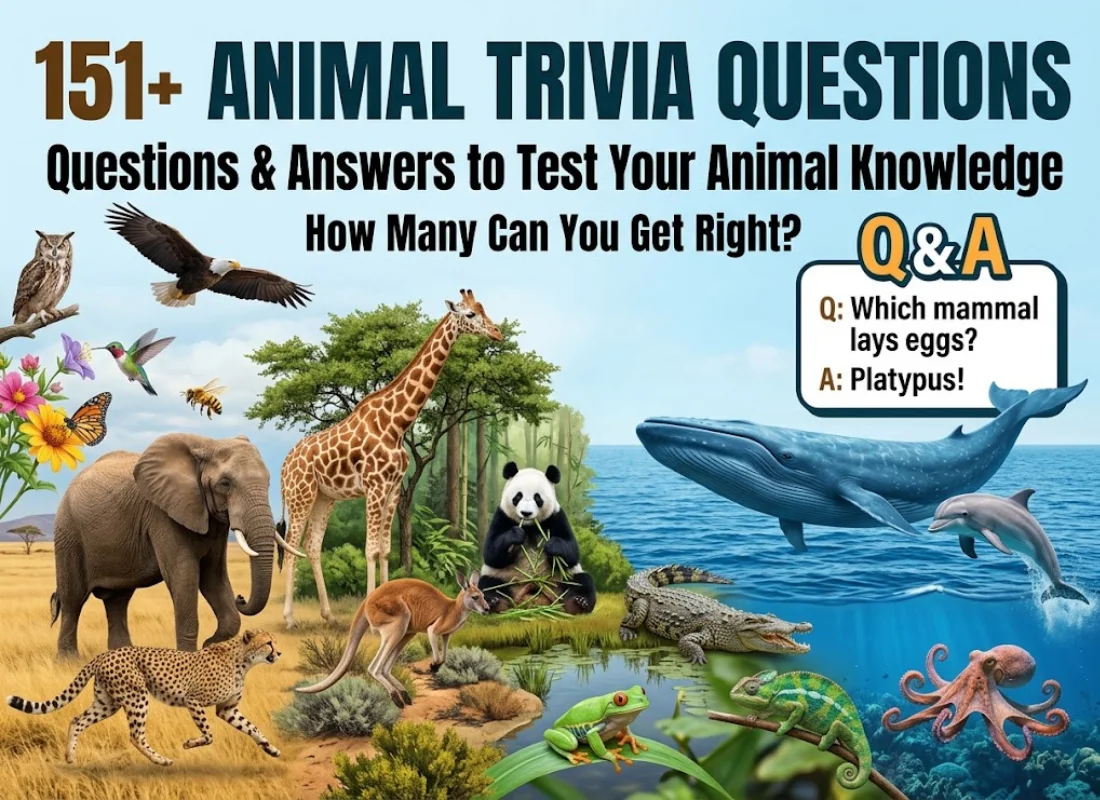
Can you name the only mammal that lays eggs? Do you know which bird can fly backward? These kinds of animal trivia questions and answers trip up even lifelong animal lovers, and that’s what makes them so much fun.
Below you’ll find 151+ animal trivia questions and answers covering mammals, birds, ocean life, reptiles, insects, and more. Use them for a classroom game, a trivia night, or just to see how much you really know about the animal kingdom.
Table of Contents
Mammal Animal Trivia Questions and Answers
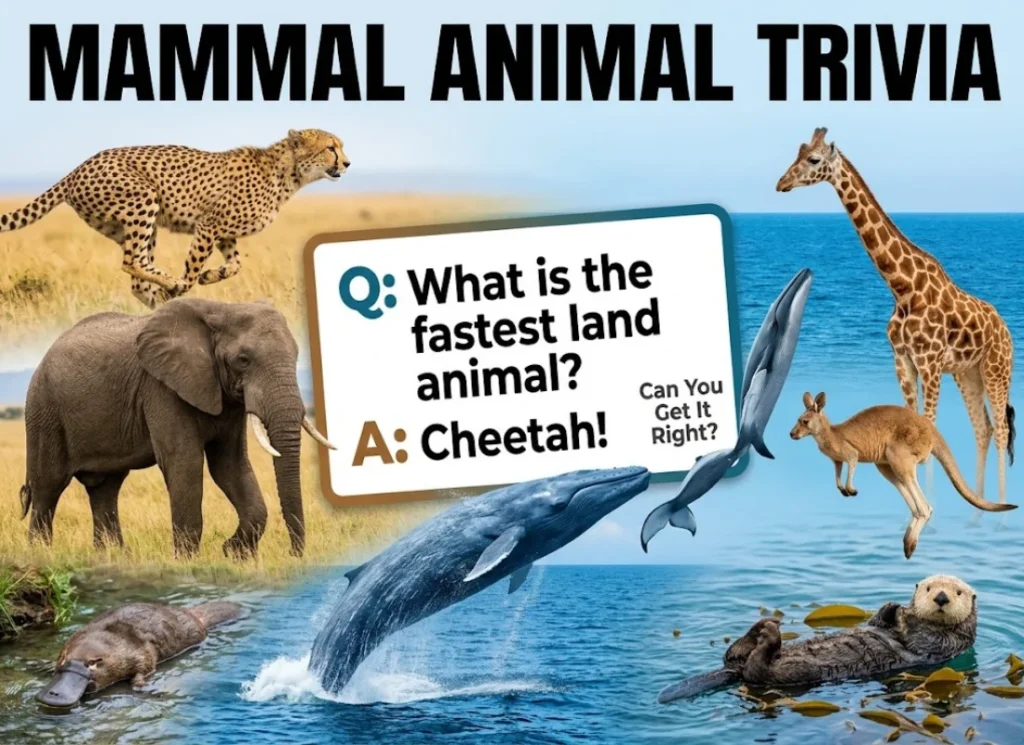
Mammals are warm-blooded animals that feed their young milk, and this group holds some of the biggest and smallest creatures on Earth. These animal trivia questions cover the mammals you know and a few surprises.
1. What is the fastest land animal? Answer: The cheetah. It can reach speeds of 70 miles per hour in short bursts, faster than most cars can accelerate.
2. What is the largest land animal? Answer: The African elephant. Males can weigh up to 13,000 pounds and use their large ears to release body heat.
3. What is the largest animal to ever exist? Answer: The blue whale. It can grow past 90 feet long and its heart alone is the size of a small car.
4. What is the smallest mammal in the world? Answer: The bumblebee bat, also called Kitti’s hog-nosed bat. It weighs less than a penny.
5. Which two mammals lay eggs instead of giving birth? Answer: The platypus and the echidna. Both belong to a rare group called monotremes.
6. What is the tallest animal in the world? Answer: The giraffe. Its tongue alone can stretch 18 inches to reach leaves on thorny branches.
7. Which animal has the highest blood pressure of any mammal? Answer: The giraffe. Its heart has to pump hard to push blood all the way up its long neck.
8. Do giraffes have vocal cords? Answer: For years, scientists believed they did not, though low-frequency humming has since been recorded in giraffes at night.
9. What color is a polar bear’s skin under its fur? Answer: Black. This helps the bear soak up heat from the sun more efficiently in freezing habitats.
10. Is polar bear fur actually white? Answer: No. Each hair is clear and hollow, and it only looks white because it scatters light like snow does.
11. What is the only mammal capable of true, sustained flight? Answer: The bat. Flying squirrels glide, but bats are the only mammals that truly fly using powered wingbeats.
12. Which animal is famous for carrying its young in a pouch? Answer: The kangaroo. A baby kangaroo, called a joey, is about the size of a jellybean at birth.
13. What is a female kangaroo’s baby-carrying pouch actually built for? Answer: It shelters the joey while it continues developing outside the womb for several months.
14. Which farm-friendly mammal is considered one of the smartest animals on Earth? Answer: The pig. Pigs can learn faster than dogs and even use mirrors to find hidden food.
15. What mammal appears to be naturally resistant to cancer? Answer: The naked mole rat. Scientists have studied its cells for decades trying to understand why.
16. Which mammal is the only one covered in hard, protective scales? Answer: The pangolin. When threatened, it curls into a tight, armored ball.
17. How many hours a day does a koala typically sleep? Answer: Between 18 and 22 hours. Its eucalyptus diet is low in calories and hard to digest, so it saves energy by resting.
18. Which sea mammal has the densest fur of any animal on the planet? Answer: The sea otter. It can have up to one million hairs per square inch to stay warm without a layer of blubber.
19. Why do sea otters hold hands while sleeping? Answer: This behavior, called rafting, keeps them from drifting apart in ocean currents.
20. What is the only cat species that lives and hunts in social groups? Answer: The lion. A group of lions is called a pride.
21. Which African animal is closely related to whales and dolphins? Answer: The hippopotamus. DNA studies show hippos share a common ancestor with cetaceans from about 55 million years ago.
22. Which land mammal is considered the most dangerous to humans in Africa? Answer: The hippopotamus, due to its aggressive territorial behavior near rivers and lakes.
23. What is unusual about a wombat’s droppings? Answer: They are cube-shaped, which helps them stack without rolling away and mark territory.
24. Which small primate produces a toxic bite from glands near its elbows? Answer: The slow loris. It is one of the only venomous primates known.
25. What animal is often called the “ship of the desert”? Answer: The camel. Its hump stores fat, not water, which the body converts into energy and moisture.
26. How long can a camel go without drinking water? Answer: Camels can survive for over a week without water, drawing on fat reserves and reducing water loss through sweat.
27. Which rodent is the largest in the world? Answer: The capybara. It can weigh over 100 pounds and is a strong swimmer.
28. What percentage of a giant panda’s diet is bamboo? Answer: About 99%. Pandas can eat up to 84 pounds of it in a single day.
29. Which animal shares nearly 99% of its DNA with humans? Answer: The chimpanzee. Bonobos come in a close second in genetic similarity.
30. What black-and-white burrowing mammal lives in a den called a “sett”? Answer: The badger.
31. Which mammal has the second-largest brain of any land animal? Answer: The elephant. Its brain can weigh around 11 pounds.
32. What unusual sense do elephants use to “hear” through the ground? Answer: They detect low-frequency seismic vibrations through their feet and trunk, allowing communication over long distances.
33. What animal is nicknamed the “Asian unicorn” because it’s so rarely seen? Answer: The saola, a critically endangered mammal found only in Vietnam and Laos.
34. Which mammal has a nose covered in 22 tentacle-like sensory organs? Answer: The star-nosed mole. It uses touch, not sight, to hunt underground.
35. What is the world’s largest species of primate? Answer: The gorilla.
Bird Animal Trivia Questions and Answers
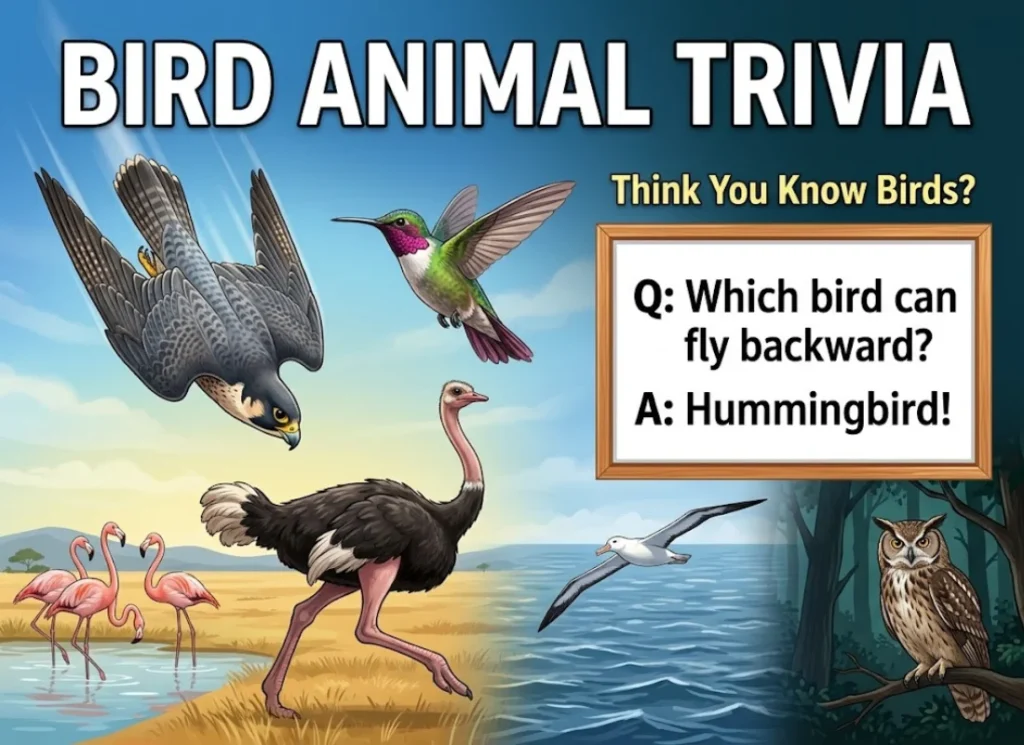
Birds are the only living animals with feathers, and their world is full of speed records, strange courtship rituals, and long-distance travel. These bird trivia questions cover the basics and a few facts most people miss.
36. What is the fastest bird, and the fastest animal, on Earth? Answer: The peregrine falcon. In a hunting dive, it can top 240 miles per hour.
37. Which bird is the only one known to fly backward? Answer: The hummingbird. Its wings beat up to 80 times per second.
38. How fast does a hummingbird’s heart beat? Answer: Over 1,200 beats per minute during activity, dropping to around 250 at rest.
39. What is the largest living bird in the world? Answer: The ostrich. It cannot fly, but it can run up to 45 miles per hour.
40. Why can’t ostriches fly? Answer: Their wings are too small to lift their large, heavy bodies off the ground.
41. Which bird has the largest wingspan of any living species? Answer: The wandering albatross, with a wingspan that can reach 11 feet.
42. What flying technique lets the albatross travel thousands of miles with barely a wingbeat? Answer: Dynamic soaring, which uses shifting wind currents just above the ocean’s surface.
43. Which bird makes the longest migration of any animal on Earth? Answer: The Arctic tern. It travels from the Arctic to Antarctica and back each year, covering up to 50,000 miles.
44. What is a group of flamingos called? Answer: A flamboyance.
45. Why are flamingos pink? Answer: They aren’t born that way. Their color comes from carotenoid pigments found in the algae and shrimp they eat.
46. How far can an owl rotate its head? Answer: Up to 270 degrees, thanks to extra vertebrae in its neck.
47. Which flightless, nocturnal bird is one of the rarest in the world? Answer: The kakapo, a native of New Zealand also called the owl parrot.
48. Which male bird performs elaborate stick-and-object arrangements to attract a mate? Answer: The bowerbird. It builds and decorates a structure called a bower.
49. Which bird species is famous for mimicking almost any sound it hears? Answer: The lyrebird, capable of copying chainsaws, camera shutters, and other birds’ calls.
50. How does a male frigatebird attract a mate? Answer: It inflates a bright red throat pouch during courtship displays.
51. Which chick is born with claws on its wings to help it climb? Answer: The hoatzin, found in South American wetlands.
52. What is the smallest known bird in the world? Answer: The bee hummingbird, native to Cuba, which is barely larger than an actual bee.
53. What is the most common bird species in the world? Answer: The chicken. Domesticated chickens outnumber almost every other bird species on Earth.
54. What bird was last confirmed seen in 1662 and is now a symbol of extinction? Answer: The dodo, a flightless bird once native to Mauritius.
55. What is the scientific study of birds called? Answer: Ornithology.
56. Which bird can sleep while still flying? Answer: The common swift. Some individuals stay airborne for months at a time without landing.
57. Which bird uses its sense of smell, rather than sight, to find dead animals to eat? Answer: The turkey vulture.
58. What is a baby swan called? Answer: A cygnet.
59. Which bird stores thousands of food locations in its memory to survive winter? Answer: The black-capped chickadee.
60. What is a male swan called? Answer: A cob.
61. Which bird has the strongest bite force relative to its size? Answer: Large birds of prey, such as the harpy eagle, are known for an exceptionally powerful grip and bite.
62. What is the largest species of eagle in the world? Answer: The harpy eagle, found in Central and South American rainforests.
63. Which bird lays the largest egg of any living species? Answer: The ostrich. One egg can weigh about 3 pounds, equal to roughly two dozen chicken eggs.
64. Which bird can fly for over 200 miles per hour only while diving? Answer: The peregrine falcon, whose regular flying speed is far slower than its dive speed.
65. What are baby birds called before they leave the nest? Answer: Fledglings once they grow flight feathers and prepare to leave.
Ocean and Marine Animal Trivia Questions and Answers
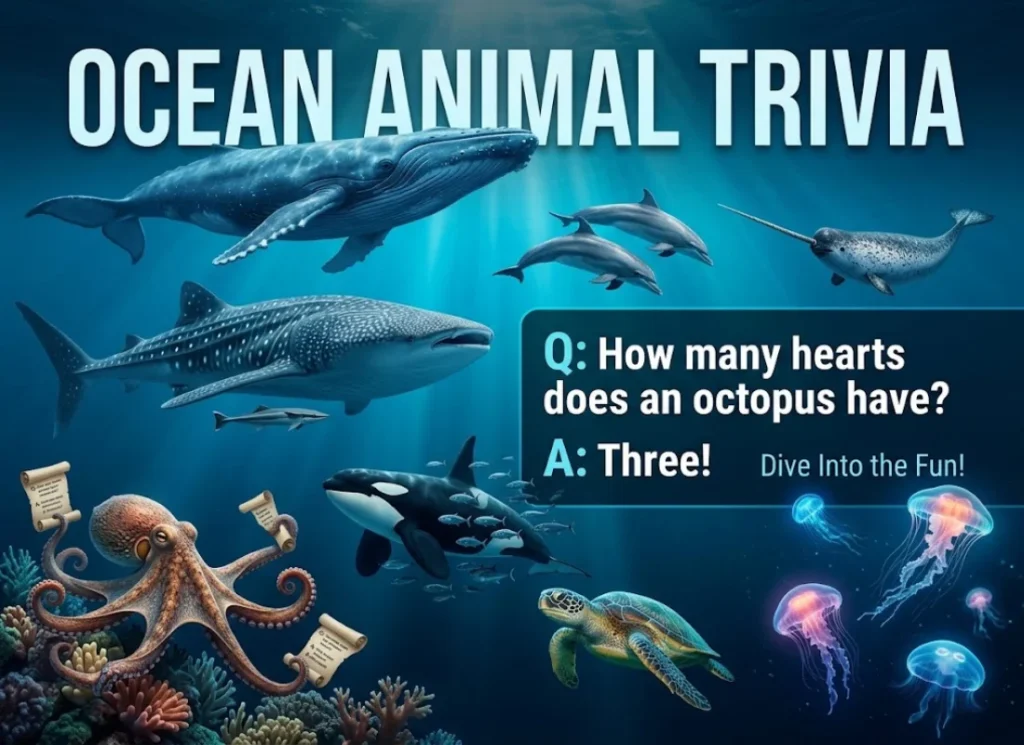
The ocean holds the largest animal that has ever lived along with some of the strangest creatures known to science. These ocean animal trivia questions dive into marine mammals, fish, and invertebrates.
66. How many hearts does an octopus have? Answer: Three. Two pump blood to the gills, and one pumps it to the rest of the body.
67. Why is octopus blood blue instead of red? Answer: It uses a copper-based protein called hemocyanin to carry oxygen, instead of the iron-based hemoglobin found in human blood.
68. What is the largest fish in the ocean? Answer: The whale shark. Despite its size, it feeds mostly on tiny plankton.
69. What is the fastest animal in the ocean? Answer: The sailfish, which can reach speeds close to 68 miles per hour.
70. Is a killer whale actually a whale? Answer: No. The orca is technically the largest member of the dolphin family.
71. How do dolphins find prey in dark or murky water? Answer: Through echolocation, sending out clicks and reading the echoes that bounce back.
72. What is a narwhal’s tusk actually made of? Answer: It is an elongated tooth, not a horn, and can grow up to 10 feet long.
73. Why does horseshoe crab blood appear blue? Answer: It contains hemocyanin, the same copper-based compound found in octopus blood.
74. Which jellyfish species is considered biologically immortal? Answer: Turritopsis dohrnii. When stressed or aging, it can revert to an earlier life stage and start over.
75. How do sea otters keep from drifting apart while resting? Answer: They wrap themselves in strands of kelp to stay anchored in one spot.
76. Which marine animal can eject its own internal organs as a defense? Answer: The sea cucumber. It regrows the lost organs over time.
77. Which fish is known for inflating its body when it feels threatened? Answer: The pufferfish.
78. What is unusual about the mimic octopus? Answer: It can imitate the appearance and movement of other sea creatures, such as lionfish and flatfish, to avoid predators.
79. Which fish can survive out of water and move across land using its fins? Answer: The mudskipper.
80. How does a seahorse reproduce? Answer: The male carries the fertilized eggs in a pouch and gives birth to the young, a rare role reversal in the animal world.
81. What lets sea turtles drink salty ocean water safely? Answer: Specialized glands near their eyes that filter out excess salt.
82. What decides the sex of a baby sea turtle? Answer: Nest temperature. Warmer sand tends to produce females, and cooler sand tends to produce males.
83. Which animal uses stones as tools to crack open shellfish? Answer: The sea otter.
84. What defense mechanism does the hagfish use against predators? Answer: It releases large amounts of thick, sticky slime that can clog a predator’s gills.
85. Which whale species produces some of the loudest sounds recorded in nature? Answer: The sperm whale. Its echolocation clicks can reach 230 decibels.
86. What is the largest known animal to ever swim the oceans? Answer: The blue whale, larger than any dinosaur known to science.
87. How many gallons of blood can a blue whale’s heart pump with each beat? Answer: Roughly 58 gallons, at a resting rate of only two beats per minute during deep dives.
88. What animal phylum do jellyfish belong to? Answer: Cnidaria, a group that also includes coral and sea anemones.
89. Which humpback whale behavior is used to communicate across long distances? Answer: Complex whale songs, which can travel for miles underwater.
90. What allows a shark to sense the tiny electrical fields produced by other animals? Answer: A special organ called the ampullae of Lorenzini, located on its snout.
91. Are sharks mammals? Answer: No. Sharks are fish. They breathe through gills and are cold-blooded, unlike whales and dolphins.
92. How long can leatherback sea turtles travel during migration? Answer: Between 10,000 and 12,000 miles across entire ocean basins.
93. What is the closest living relative of the hippopotamus? Answer: Whales and dolphins, according to DNA evidence.
94. Which small marine creature has been found living deeper than almost any other known animal? Answer: Certain species of amphipods and snailfish, discovered in the deepest ocean trenches on Earth.
95. What color is a lobster’s blood before it hits the air? Answer: Clear. It turns slightly blue once exposed to oxygen.
Reptile, Amphibian, and Insect Animal Trivia Questions and Answers
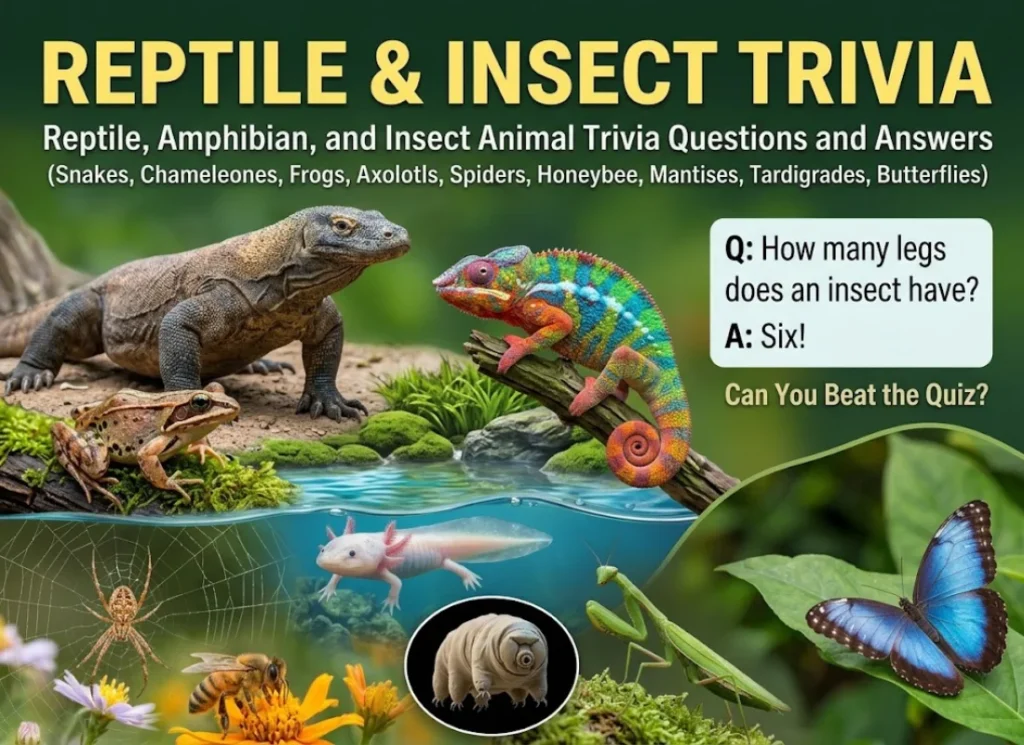
Cold-blooded creatures and insects make up the largest share of animal species on Earth. This section of animal trivia questions and answers covers reptiles, amphibians, and the small but mighty insect world.
96. Is a snake’s venom the same thing as poison? Answer: No. Venomous animals inject toxins through a bite or sting, while poisonous animals release toxins when touched or eaten.
97. Which reptile produces venom and dangerous bacteria in its bite? Answer: The Komodo dragon, the world’s largest living lizard.
98. Why do chameleons really change color? Answer: Mainly for temperature regulation and communication with other chameleons, not for camouflage as many people believe.
99. What skin cells allow a chameleon to shift colors? Answer: Chromatophores, layered cells that reflect light differently depending on the animal’s mood or temperature.
100. Which frog species can freeze solid during winter and survive? Answer: The wood frog. Natural antifreeze in its blood protects its organs from ice damage.
101. What is unusual about the axolotl compared to other amphibians? Answer: It never goes through metamorphosis. It keeps its external gills and stays aquatic for life.
102. What is a baby frog called before it grows legs? Answer: A tadpole.
103. Which body part do frogs use to breathe in addition to their lungs? Answer: Their skin, which absorbs oxygen directly from water or moist air.
104. What is the longest venomous snake species in the world? Answer: The king cobra, which can grow to nearly 19 feet long.
105. Which turtle species can survive months without oxygen by slowing its metabolism? Answer: The painted turtle.
106. What is the name of the “third eye” found on top of many lizards’ heads? Answer: The parietal eye, which detects light and helps regulate body temperature.
107. How many legs does a spider typically have? Answer: Eight, along with two additional appendages called pedipalps.
108. Which insect performs a “waggle dance” to share directions to food? Answer: The honeybee. The angle and length of the dance point other bees toward the food source.
109. What happens to a male honeybee, called a drone, after mating? Answer: He dies shortly after, since his only role is reproduction.
110. Which female insect is known for eating her mate after breeding? Answer: The praying mantis, though this behavior does not happen in every encounter.
111. How long can a cockroach survive without its head? Answer: Up to several weeks. It breathes through small holes along its body rather than through its head.
112. Why does a headless cockroach eventually die? Answer: It can no longer eat or drink, even though it can survive briefly without its head.
113. Which insect is considered the strongest in the world relative to its size? Answer: The dung beetle, which can pull over 1,000 times its own body weight.
114. How many eyes does a bee typically have? Answer: Five, two large compound eyes and three simple eyes on top of its head.
115. Which tiny creature can survive the vacuum of outer space? Answer: The tardigrade, also known as a water bear.
116. How does a tardigrade survive extreme conditions? Answer: It enters a state called cryptobiosis, where its metabolism nearly shuts down until conditions improve.
117. What percentage of all known animal species on Earth are insects? Answer: Around 80%.
118. Which insect is responsible for the most human deaths worldwide each year? Answer: The mosquito, due to the diseases it can spread.
119. How many legs does an insect have? Answer: Six, which separates true insects from spiders and other arachnids.
120. Which body part do butterflies use to taste their food? Answer: Their feet.
121. What percentage of a butterfly or moth’s life is typically spent as a caterpillar eating? Answer: The majority of its early life, since the caterpillar stage is focused almost entirely on feeding and growth.
122. What is the largest butterfly species in the world? Answer: The Queen Alexandra’s birdwing, native to New Guinea.
123. Which insect can jump around 100 times its own body length? Answer: The flea.
124. What loud insect is considered the noisiest in the insect world? Answer: The cicada, whose calls can be heard from over a mile away in some species.
125. What type of animal is a caecilian? Answer: A limbless amphibian that looks similar to a large worm or snake.
Farm and Fun Random Animal Trivia Questions and Answers
This final round mixes barnyard basics with wild records and word origins. These random animal trivia questions work well as a closing round for any quiz.
126. How many stomach compartments does a cow have? Answer: Four. This allows it to digest tough grass efficiently through a process called rumination.
127. What is a baby goat called? Answer: A kid.
128. What is a female horse called? Answer: A mare.
129. What sound does a sheep make? Answer: A baa.
130. What is a group of sheep called? Answer: A flock.
131. What is a group of cows called? Answer: A herd.
132. What helps ducks swim easily through water? Answer: Their webbed feet.
133. What is a male sheep called? Answer: A ram.
134. Where does the word “carnivore” come from? Answer: The Latin word caro, meaning flesh, referring to animals that mainly eat meat.
135. Where does the word “herbivore” come from? Answer: The Latin word herba, meaning plant, describing animals that eat mostly vegetation.
136. Where does the word “omnivore” come from? Answer: The Latin word omni, meaning “all,” describing animals that eat both meat and plants.
137. What do you call animals that spend most of their lives in trees? Answer: Arboreal animals, from the Latin word for tree.
138. What is the only big cat that cannot roar? Answer: The cheetah. It can only purr and chirp.
139. Which land mammal is believed to have the longest lifespan? Answer: The tortoise. Some individuals have lived well past 150 years.
140. Which marine animal holds the record for longest known lifespan? Answer: The ocean quahog clam. One specimen, nicknamed “Ming,” was estimated at over 500 years old.
141. Which shark species may live longer than 400 years? Answer: The Greenland shark, believed to be the longest-living vertebrate known.
142. What is a group of lions called? Answer: A pride.
143. What is a group of crows called? Answer: A murder.
144. What is a group of owls called? Answer: A parliament.
145. What is a group of dolphins called? Answer: A pod.
146. What is a group of fish swimming together called? Answer: A school.
147. Which mammal is able to run backward on its own feet to move along branches more easily? Answer: The kinkajou, which can rotate its feet to face backward while climbing.
148. What animal predicts six more weeks of winter in American folklore if it sees its shadow? Answer: The groundhog.
149. Which animal is often nicknamed “earth pig” due to its digging habits? Answer: The aardvark, from the Afrikaans words for “earth” and “pig.”
150. What is the collective term for young animals born from the same litter? Answer: A litter, commonly used for dogs, cats, and pigs.
151. What is a baby elephant called? Answer: A calf.
152. Which farm bird is known for its bright red comb and early morning crowing? Answer: The rooster.
153. What do we call a scientist who studies animal behavior? Answer: An ethologist.
154. Which large land mammal can go its entire life without directly drinking water? Answer: The kangaroo rat, which gets moisture from the seeds it eats.
155. What is the scientific term for animals that regulate their body temperature internally? Answer: Endothermic, or warm-blooded, animals.
FAQs
What are some good animal trivia questions and answers for kids?
Simple questions work best for kids, such as asking the fastest land animal (cheetah), the tallest animal (giraffe), or which bird can’t fly (ostrich). These questions have clear, memorable answers that build confidence early.
What is the hardest animal trivia question to answer?
Questions about lesser-known species tend to be hardest, such as identifying the two egg-laying mammals or naming the longest-living animal on record. These require deeper knowledge than everyday animal facts.
How many animal trivia questions and answers are in this list?
This list includes 155 animal trivia questions and answers, organized by category into mammals, birds, ocean life, reptiles, amphibians, insects, and farm and random facts.
What is a good animal trivia question for a quiz night?
Mid-difficulty questions work best for quiz nights, such as asking which animal has three hearts (octopus) or which mammal lays eggs (platypus). These strike a balance between fun and challenging.
What is the most interesting animal fact people don’t know?
Many people don’t know that a giraffe’s blood pressure is roughly double that of a human, or that an octopus has blue blood instead of red. Facts like these tend to surprise even dedicated animal fans.
Conclusion
From the giraffe’s sky-high blood pressure to the octopus’s three hearts, the animal kingdom is full of surprises that make for great conversation and even better trivia nights. Save this list of animal trivia questions and answers, share it with friends and family, and see who really knows their wildlife facts.

William Vicky is the lead writer and trivia curator at Trivia Questioners, with a passion for uncovering fascinating facts across history, science, pop culture, and general knowledge. He loves crafting questions that challenge and delight readers of all ages.